Healthcare App Development Canada: PHIPA and PIPEDA Guide


Healthcare app development Canada is booming because digital health has moved from “nice to have” to “expected.” Patients book appointments online, see doctors over video, refill prescriptions from their phones, and check lab results without calling the clinic. Clinics, hospitals, pharmacies, and health startups are racing to meet that demand, but there is one thing that separates a successful health app from a costly mistake: privacy compliance.
In Canada, health information is some of the most protected data you can handle. Two laws sit at the centre of almost every project: Ontario’s Personal Health Information Protection Act (PHIPA) and the federal Personal Information Protection and Electronic Documents Act (PIPEDA). Get them right, and patients trust you. Get them wrong, and you face fines, investigations, and lost contracts.
This guide explains everything you need to know about healthcare app development Canada projects in plain language: how PHIPA and PIPEDA work, how they apply to apps, provincial rules, data residency, Health Canada requirements, must-have features, tech stack, costs, and how to choose the right development partner.
Why Healthcare App Development in Canada Is Growing Fast
Several forces are driving demand for healthcare app development in Canada:
- Doctor shortages and long wait times: Millions of Canadians struggle to find a family doctor, so virtual care fills a real gap.
- Patient expectations: People now expect healthcare to be as easy to access as banking or shopping.
- Remote and rural access: Large distances make virtual visits and remote patient monitoring essential outside major cities.
- Aging population: Chronic disease management, medication reminders, and home monitoring are in high demand.
- AI in healthcare: Clinics are adopting AI-powered triage, documentation, and scheduling tools to reduce admin workload.
- Provincial digital health investment: Provinces continue to expand online patient portals, e-referrals, and connected health records.
The opportunity is clear. The challenge is building apps that meet Canada’s strict privacy standards from the very first line of code.
Types of Healthcare Apps Built in Canada
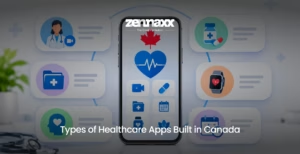
Before you think about compliance, you need to know what kind of app you are building, because the rules that apply depend on what the app does and who uses it.
Virtual Care and Telehealth Apps
A virtual care app Canada patients can use for video visits, secure messaging, and e-prescriptions is one of the most requested products today. These apps connect patients with physicians, nurse practitioners, therapists, and specialists. If you are planning one, our guide to telehealth software covers the core building blocks in detail.
Online Pharmacy and Prescription Apps
Online pharmacy app development covers prescription uploads, refill requests, medication reminders, pharmacist chat, and home delivery. Pharmacies are regulated by provincial pharmacy colleges, so these apps must also respect professional practice rules around prescriptions and patient counselling.
Patient Portals and EMR-Connected Apps
These apps give patients access to their records, lab results, visit summaries, and appointment history. They often connect to electronic medical record (EMR) systems used by clinics and hospitals.
Remote Patient Monitoring Apps
Remote patient monitoring apps collect data from wearables and home devices, such as blood pressure cuffs, glucose monitors, and pulse oximeters, and share it with care teams.
Mental Health and Wellness Apps
Mental health apps offer therapy sessions, mood tracking, guided programs, and crisis resources. Wellness and fitness apps may fall outside health privacy laws if they are not used by a healthcare provider, but they are still covered by general privacy law.
Clinic Management and Scheduling Apps
These tools handle online booking, reminders, check-ins, billing, and staff schedules for clinics, dental offices, physiotherapy centres, and labs.
Understanding PHIPA: Ontario’s Health Privacy Law
PHIPA, the Personal Health Information Protection Act, 2004, is Ontario’s law for how personal health information (PHI) is collected, used, disclosed, stored, and destroyed. If your app serves Ontario patients or Ontario healthcare providers, building a PHIPA compliant app is not optional.
Who PHIPA Applies To
PHIPA is built around a few key roles:
- Health information custodians (HICs): Doctors, hospitals, clinics, pharmacies, labs, long-term care homes, and other providers who have custody or control of PHI.
- Agents: People or companies that act for a custodian, such as staff, contractors, or some app providers handling PHI on the custodian’s behalf.
- Electronic service providers: Technology vendors that supply software or services so custodians can collect, use, or store PHI electronically.
- Health information network providers (HINPs): Providers whose systems let two or more custodians share PHI electronically. HINPs carry extra duties under PHIPA’s regulations.
Most health tech companies are not custodians themselves. They usually act as agents, electronic service providers, or HINPs for clinics and hospitals. That role decides your legal obligations, so it should be defined in your contracts from day one.
Key PHIPA Requirements for Healthcare Apps
- Consent: Custodians generally need consent to collect, use, or disclose PHI. Implied consent can apply within a patient’s “circle of care,” but express consent is needed in many other cases.
- Limited use: Collect and use only the PHI needed for the purpose.
- Safeguards: Take reasonable steps to protect PHI against theft, loss, and unauthorized access, use, or disclosure.
- Access and correction: Patients have the right to access and request corrections to their health records.
- Breach notification: Affected patients must be notified when their PHI is stolen, lost, or used without authority, and certain breaches must be reported to the Information and Privacy Commissioner of Ontario (IPC).
- Vendor duties: Electronic service providers and HINPs must not use or disclose PHI beyond what the custodian allows. HINPs must also notify custodians of breaches, keep records of access, assess privacy and security risks, and sign written agreements with custodians.
PHIPA Penalties
PHIPA enforcement has real teeth. From January 1, 2024, the IPC can issue administrative monetary penalties of up to $50,000 for individuals and $500,000 for organizations. For the most serious cases, prosecution can lead to fines of up to $200,000 for individuals and $1,000,000 for organizations. The Information and Privacy Commissioner of Ontario publishes guidance and decisions that every Ontario health app team should review.
Understanding PIPEDA: Canada’s Federal Privacy Law
PIPEDA, the Personal Information Protection and Electronic Documents Act, applies to private-sector organizations that collect, use, or disclose personal information during commercial activity. That includes health tech startups, app vendors, digital health platforms, and many private clinics in provinces without their own similar health privacy law.
The 10 Fair Information Principles
PIPEDA is built on ten principles that shape how your app handles data:
- Accountability
- Identifying purposes
- Consent
- Limiting collection
- Limiting use, disclosure, and retention
- Accuracy
- Safeguards
- Openness
- Individual access
- Challenging compliance
Breach Reporting Under PIPEDA
If a breach creates a real risk of significant harm, organizations must report it to the Office of the Privacy Commissioner of Canada, notify affected individuals, and keep records of all breaches. The OPC’s official PIPEDA overview is the best starting point for your compliance checklist. For a developer-focused breakdown, see our guide on PIPEDA compliance for custom software.
What Bill C-36 Means for Health Apps
Federal privacy law is changing. In June 2026, the government introduced Bill C-36, which would replace the privacy part of PIPEDA with a new Protecting Privacy and Consumer Data Act (PPCDA). As currently written, it would create a new regulator with order-making powers, introduce much larger penalties, and require a privacy impact assessment before personal information is transferred outside Canada. The bill is still moving through Parliament and may change, but building with privacy by design today will make the transition far easier.
PHIPA vs. PIPEDA: Which Law Applies to Your App?
This is one of the most common questions in healthcare app development Canada projects. In many cases, both laws matter.
| Factor | PHIPA | PIPEDA |
| Type of law | Ontario provincial health privacy law | Federal private-sector privacy law |
| Who it covers | Health information custodians, their agents, and service providers in Ontario | Private organizations handling personal information in commercial activity |
| Type of data | Personal health information | All personal information, including health data |
| Regulator | Information and Privacy Commissioner of Ontario | Office of the Privacy Commissioner of Canada |
| Breach reporting | Notify patients; report certain breaches to the IPC | Report breaches with real risk of significant harm to the OPC and notify individuals |
| Penalties | Administrative penalties and prosecution fines up to $1M for organizations | Fines for certain offences; much higher penalties proposed under Bill C-36 |
PHIPA has been recognized as substantially similar to PIPEDA for health information custodians in Ontario. In practice, that means PHIPA usually governs PHI handled by Ontario providers, while PIPEDA can still apply to your company’s commercial activities, such as your own customer data, marketing, or data moving across provincial or national borders.
Quick Rule of Thumb
- Serving Ontario clinics or patients with health data? Plan for PHIPA.
- Running a private health tech business across Canada? Plan for PIPEDA too.
- Operating in other provinces? Add each province’s health privacy law to your list.
Provincial Health Privacy Laws Beyond Ontario
Canada does not have one single health privacy law. If you plan to serve patients in several provinces, your app must account for each one. Key laws include:
- Alberta: Health Information Act (HIA)
- British Columbia: Personal Information Protection Act (PIPA) for private organizations, plus public-sector rules for health authorities
- Saskatchewan: Health Information Protection Act (HIPA)
- Manitoba: Personal Health Information Act (PHIA)
- Quebec: Law 25 and the Act respecting health and social services information, which include strict consent and cross-border transfer rules
- New Brunswick: Personal Health Information Privacy and Access Act (PHIPAA)
- Nova Scotia: Personal Health Information Act (PHIA)
- Newfoundland and Labrador: Personal Health Information Act (PHIA)
The smartest approach is to design your app around the strictest common requirements, then add province-specific settings for consent, retention, and data location.
Health Data Residency in Canada: Where Should Patient Data Live?
Health data residency Canada is one of the biggest decisions in your project. Here is the reality:
- PIPEDA does not ban storing personal data outside Canada, but organizations remain responsible for protecting it and must be transparent about cross-border transfers.
- Some provincial public-sector rules and many hospital and health authority contracts require patient data to stay in Canada.
- Quebec requires a privacy impact assessment before personal information leaves the province.
- Bill C-36, if passed, would require a privacy impact assessment before transferring data outside Canada.
Because of these rules, and because data sovereignty is a growing concern for patients and public buyers, most Canadian health apps host PHI in Canadian cloud regions. Major providers offer them, including AWS (Montreal and Calgary), Microsoft Azure (Toronto and Quebec City), and Google Cloud (Montreal and Toronto). Hosting in Canada also makes it far easier to win contracts with clinics, hospitals, and provincial health agencies.
Health Canada Rules for Medical Software
Privacy is not the only regulation to plan for. If your app diagnoses, treats, monitors, or helps manage a medical condition, Health Canada may classify it as Software as a Medical Device (SaMD).
- Medical devices in Canada are classified from Class I (lowest risk) to Class IV (highest risk).
- Class II, III, and IV devices need a Medical Device Licence before they can be sold.
- General wellness apps, fitness trackers, and simple scheduling tools usually fall outside these rules.
- Quality standards such as ISO 13485 are often expected for regulated medical software.
Get a regulatory assessment early. Discovering late that your app needs a licence can add months to your timeline.
Must-Have Features for a Compliant Healthcare App
A great health app balances usability with security. Here is what patients, providers, and administrators expect.
Patient-Facing Features
- Secure sign-up with identity verification
- Provincial health card validation (OHIP, AHCIP, and others)
- Appointment booking, reminders, and rescheduling
- Video consultations and secure in-app messaging
- Prescription refills and medication reminders
- Access to lab results, visit notes, and health records
- Bilingual English and French support
- Consent management and privacy settings
Provider and Admin Features
- Patient profiles and EMR or EHR integration
- Scheduling, queue management, and waitlists
- E-prescribing and e-referrals
- Clinical notes and documentation tools
- Billing and provincial claims support
- Role-based dashboards and reporting
Security and Compliance Features
- Multi-factor authentication
- Encryption of data in transit and at rest
- Role-based access control (only the right people see the right data)
- Detailed audit logs of who accessed which records and when
- Automatic session timeouts
- Secure backups and disaster recovery
- Breach detection, alerts, and incident response workflows
- Data retention and secure deletion controls
Advanced Features That Set You Apart
- AI-assisted triage, symptom checkers, and clinical note summaries
- Remote patient monitoring with wearable and IoT integration
- FHIR interoperability for smooth data exchange with other systems
- Smart scheduling that reduces no-shows
- Accessibility features that follow WCAG guidelines
Step-by-Step Process for Building a PHIPA and PIPEDA Compliant App
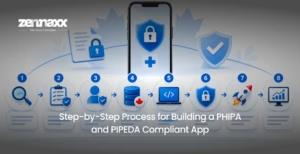
Here is a practical roadmap that keeps compliance at the centre of the build. For a broader look at planning and launching, you can also read our full healthcare app development guide.
1. Discovery and Use Case Definition
Define your users, the problem you solve, and the provinces you will serve. Decide whether you are a custodian, agent, electronic service provider, or HINP.
2. Compliance Mapping and Privacy Impact Assessment
Map every law that applies, complete a privacy impact assessment (PIA), and run a threat risk assessment (TRA). This shapes your architecture and contracts.
3. Privacy-by-Design UX
Design clear consent screens, simple privacy settings, and easy access to records. Patients should always understand what data you collect and why.
4. Secure Architecture and Canadian Hosting
Choose Canadian cloud regions, plan encryption, define access roles, and set up audit logging before development begins.
5. Agile Development
Build in short sprints, starting with a minimum viable product (MVP). Add advanced features once the core is stable and compliant.
6. Security and Compliance Testing
Run penetration tests, vulnerability scans, code reviews, and accessibility checks. Validate that audit logs, consent records, and breach workflows work as designed.
7. Launch With Clear Agreements
Sign data processing or agent agreements with every clinic or partner, publish a plain-language privacy policy, and train support staff on privacy procedures.
8. Ongoing Monitoring and Updates
Compliance does not end at launch. Review access logs, update risk assessments, patch vulnerabilities, and track legal changes such as Bill C-36.
Recommended Tech Stack for Healthcare Apps in Canada
| Layer | Recommended Technologies |
| Mobile apps | Flutter or React Native (cross-platform), Swift (iOS), Kotlin (Android) |
| Web portals and dashboards | React.js, Next.js, Angular |
| Backend | Node.js, Python (Django or FastAPI), .NET, Java (Spring Boot) |
| Databases | PostgreSQL, MongoDB, with encryption at rest |
| Interoperability | HL7 FHIR APIs, HL7 v2 integrations |
| Video and messaging | WebRTC, Twilio, Vonage, or other Canadian-hosted options |
| Cloud hosting | AWS, Microsoft Azure, or Google Cloud Canadian regions |
| Security | OAuth 2.0, OpenID Connect, key management services, SIEM monitoring |
| AI features | Secure LLM APIs with no data retention, custom ML models |
Healthcare App Development Canada: How Much Does It Cost?
Costs vary widely based on features, integrations, and compliance needs. The ranges below are typical market estimates.
| App Type | Estimated Cost (CAD) | Typical Timeline |
| Wellness or mental health app | $35,000 – $70,000 | 3 – 4 months |
| Telehealth or virtual care app | $70,000 – $150,000 | 4 – 7 months |
| Online pharmacy app | $60,000 – $140,000 | 4 – 6 months |
| EMR or EHR-integrated platform | $120,000 – $250,000 | 6 – 10 months |
| Remote monitoring or AI-powered platform | $150,000 – $400,000+ | 8 – 12+ months |
What Drives the Cost
- Number of platforms (iOS, Android, web)
- EMR, pharmacy, lab, and device integrations
- Privacy impact assessments, threat risk assessments, and security audits
- Health Canada regulatory work, if your app is a medical device
- Bilingual content and accessibility
- Canadian cloud hosting and ongoing maintenance
Investing in compliance up front is always cheaper than fixing a breach, rebuilding an architecture, or losing a hospital contract later.
Common Mistakes to Avoid
- Treating compliance as a final step: Privacy must be built into the architecture, not added after launch.
- Hosting PHI outside Canada without a plan: This can block contracts and create legal risk.
- Using non-compliant third-party tools: Analytics, chat, video, or AI tools that store PHI on foreign servers can create hidden exposure.
- Weak access controls: Many real-world PHIPA breaches involve staff viewing records they had no reason to access. Audit logs and role-based access help prevent this.
- Ignoring French language and accessibility: These affect adoption, especially in Quebec and among older patients.
- Skipping the regulatory check: Not knowing whether your app is a medical device can stall your launch.
How to Choose the Right Healthcare App Development Company
The right healthcare app development company should be a long-term partner, not just a coding team. Look for:
- Proven experience with PHIPA, PIPEDA, and provincial health privacy laws
- A portfolio of telehealth, pharmacy, patient portal, or EMR-integrated apps
- Strong security practices, including encryption, audit logging, and penetration testing
- Experience with Canadian cloud hosting and FHIR interoperability
- Clear documentation for PIAs, TRAs, and vendor agreements
- Transparent pricing, milestones, and post-launch support
Why Choose Zennaxx for Healthcare App Development
Zennaxx delivers custom healthcare app development services for clinics, hospitals, pharmacies, and digital health startups that need secure, scalable, and compliant products. Our team understands both the technology and the regulations behind Canadian healthcare.
With our medical app development services, you get:
- Privacy-by-design architecture aligned with PHIPA and PIPEDA
- Canadian cloud hosting and secure data handling
- Virtual care, online pharmacy, patient portal, and remote monitoring solutions
- EMR, EHR, and FHIR-based integrations
- AI-powered features built with strict data controls
- Bilingual, accessible, and user-friendly design
- Ongoing maintenance, security updates, and compliance support
Whether you are launching a new virtual clinic or modernizing an existing health platform, we help you move from idea to launch with confidence.
Final Thoughts
Canada’s digital health market offers huge potential, but trust is everything. Patients, providers, and regulators expect health apps to protect personal health information at every step. Understanding PHIPA, PIPEDA, provincial laws, data residency, and Health Canada rules is the foundation of any successful project.
With the right strategy, secure architecture, and an experienced partner, healthcare app development Canada projects can deliver better care, smoother workflows, and long-term growth. Ready to build a compliant health app that patients and providers will trust? Talk to the Zennaxx team today for a free consultation on your healthcare app development Canada project.
Frequently Asked Questions
What is the difference between PHIPA and PIPEDA?
PHIPA is Ontario’s law for personal health information held by healthcare providers and their service providers. PIPEDA is Canada’s federal law for personal information handled by private businesses during commercial activity. Many health apps need to follow both.
Does health data have to be stored in Canada?
Not always. PIPEDA does not ban storing data abroad, but some provincial rules and many healthcare contracts require Canadian storage. Most health apps host patient data in Canadian cloud regions to stay safe and win contracts.
How much does it cost to build a healthcare app in Canada?
Most healthcare apps cost between CAD $35,000 and $400,000+. Simple wellness apps sit at the lower end, while EMR-integrated, remote monitoring, and AI-powered platforms cost more.
Does my healthcare app need Health Canada approval?
Only if it qualifies as a medical device, for example if it diagnoses, treats, or monitors a medical condition. Wellness, fitness, and scheduling apps usually do not need a licence.
Is PIPEDA being replaced?
Bill C-36, introduced in June 2026, would replace PIPEDA’s privacy rules with the Protecting Privacy and Consumer Data Act. It is still before Parliament, so PIPEDA remains the law for now.