Payment Gateway Integration for Apps in Canada: The Complete Guide to Setup, Cost & Security

What Is Payment Gateway Integration?
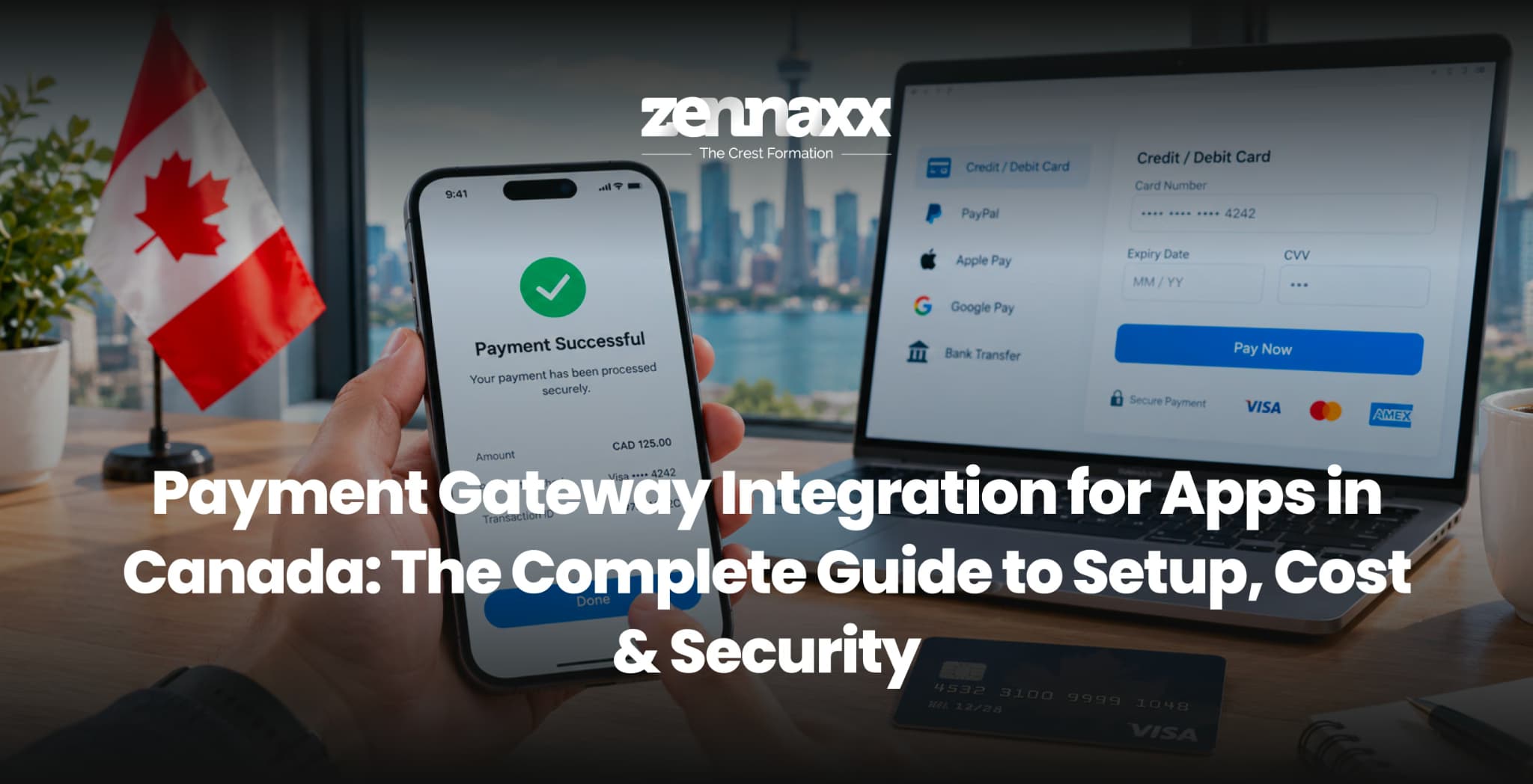
Payment gateway integration is the process of directly connecting a payment gateway, the technology that securely authorizes and processes transactions, into your mobile app, web application or software platform. It’s what lets your users pay you digitally, in real time, without ever leaving your app.
Think of a payment gateway like the point-of-sale terminal at a brick-and-mortar store. When a customer taps their card or enters their credit card number, the gateway encrypts that information and sends it to the card network and the customer’s bank for authorization, and returns an approval or decline – all in a matter of seconds. The integration connects to your product that whole infrastructure.
For Canadian businesses, whether you’re a startup based in Toronto, a healthcare provider in Ontario, or a growing e-commerce brand from coast to coast, getting your payment gateway integration right is essential. A smooth, fast and trustworthy checkout experience directly impacts conversion rates, customer retention and ultimately revenue. Research shows that more than 70% of Canadian consumers will abandon a purchase if their preferred payment option is not available. That means the depth and flexibility of your payment integration is a competitive differentiator, not just a technical requirement.
Whether you’re developing a new app from scratch or upgrading an existing platform, this guide offers detailed insights into payment gateway setup, integration methods, API options, security standards, pricing, and choosing the right development partner for the Canadian market. If you need help building the application itself, explore our mobile app development services for end-to-end app development and integration.
How a Payment Gateway Works- The Transaction Flow
Before we get into the technical integration process, it helps to understand what actually happens in a payment transaction. It’s faster than it looks, most authorizations are done in less than two seconds but there are a number of systems communicating behind the scenes.
This is what a typical flow looks like for a card payment with an integrated gateway:
Step -1 Customer Begins Payment
The user enters their card details (or uses Apple Pay, Google Pay or another saved method) on the checkout screen of your app.
Step -2 Data Encryption
The payment gateway uses TLS/SSL encryption to immediately encrypt the sensitive card data, so it is never sent over the Internet in plaintext.
Step -3 Gateway Sends to Payment Processor
The gateway forwards the encrypted transaction instruction to the payment processor, which in turn sends it to the appropriate card network (Visa, Mastercard, Interac, etc.)
Step -4 Contact Card Network Issuing Bank
The card network forwards an authorization inquiry to the customer’s bank (issuing bank). The issuing bank checks account balance, fraud rules and card status.
Step -5 Authorization Response
The issuing bank approves or declines the transaction and sends the response back through the card network to the processor and then to the gateway.
Step -6 Result Displayed in App
Within seconds your app receives the approval or decline message from the gateway and shows the appropriate confirmation or error screen to the user.
That means the money is transferred from the issuing bank to your merchant account (settlement) within one to three business days after you make the sale.
It’s important to understand this flow because each step has its own integration touchpoints, failure modes, and security considerations that your payment gateway integration needs to account for.
Types of Payment Gateway Integrations
Not all payment platform integrations are the same. The right path depends on your app architecture, user experience requirements, compliance obligations, and how much control you want over the payment UI.
Hosted Payment Page (Redirect)
The app redirects the customer to a payment page at the gateway provider. Once they pay, they’re redirected back to your app.
Best for: Small businesses, MVPs, or when reducing PCI DSS scope is the priority. Your systems never touch any card data. This is all handled by the gateway.
Trade-off: Less control over the payment experience and a less seamless journey for the user.
Embedded Checkout (iFrame or Pre-Built SDK)
The payment form is integrated right into your app’s interface via an iFrame or the gateway’s out-of-the-box SDK/widget. The gateway still processes card data but the UI feels like it is a native part of your product.
Best for: Apps that want a more integrated UX and don’t want the full PCI DSS burden of storing card data.
Trade-off: Some restrictions on UI customization relative to a full direct integration.
Direct API Integration
Your app connects directly to the payment gateway API integration layer and programmatically sends transaction requests and receives responses. Card tokenization allows you to securely capture card data so that your servers never store raw card numbers.
Best for: Mature products, high-volume platforms and businesses that need total control over the payment flow and user experience.
Trade-off: Requires good development skills and higher PCI DSS compliance or correct tokenization implementation.
Integration into In-App/Wallet
Payment is made by a stored wallet or digital payment method (Apple Pay, Google Pay, Interac e-Transfer) already stored on the user’s device or in the app.
Best for: Mobile apps where speed and convenience is critical especially in retail, food delivery and on-demand service verticals.
One of the most important early decisions in your payment system integration project is choosing the right type of integration, and it directly impacts your cost, timeline, security posture, and user experience.
Top Payment Methods Canadian Users Expect
Canada has its own unique payment landscape, separate from the US and other markets. When you build an app for Canadian users whether they’re in Toronto, Ontario or anywhere across the country, that means supporting the payment methods your users actually use, not just the ones easiest to integrate.
Credit & Debit Cards (Visa, Mastercard, Amex)
Still the most popular payment method in Canada. Any payment gateway integration should reliably process card payments on all major networks.
Interac
Interac is very Canadian, very important. Interac Debit is used at the point of sale by millions of Canadians every day, and Interac e-Transfer is one of the most popular ways to send money between individuals and small businesses. Interac Online Direct Bank e-commerce payment. Supporting Interac is a must if you’re building for the Canadian market and your app doesn’t support it, you’re immediately leaving out a big chunk of your users.
Apple Pay & Google Pay
Adoption of digital wallets is growing rapidly, especially among mobile users under the age of 45. These use device-level biometric authentication and tokenized card data, which also means they are faster and more secure than manually entered card details.
PayPal & Stripe
Still used for e-commerce and marketplace applications, especially for users who don’t want to enter their card details directly.
Buy Now, Pay Later (BNPL)
Afterpay, Klarna and Affirm are growing in Canadian retail and e-commerce, especially for higher-ticket purchases.
Pre-Authorized Debits (PAD)
PAD is commonly used for subscription services with recurring billing, insurance policies, utility payments and healthcare billing platforms that allow businesses to draw funds from a customer’s bank account on a scheduled basis with prior authorization.
For a detailed comparison of the best payment gateways in Canada for these methods, check out our guide to best payment gateways in Canada.
Payment Gateway API Integration: What Every Developer Should Know
If you are developing an integration for a payment gateway API, you must have a grasp of the technical basics of creating a secure, reliable and maintainable payment system.
RESTful API Architecture
Most modern payment gateways such as Stripe, Braintree, Square, Bambora, etc., expose RESTful APIs that your app talks to using standard HTTP methods (POST, GET). Requests and responses are in JSON format so they are relatively easy to work with in any modern tech stack.
Tokenization
Tokenization is the process of replacing sensitive card data with a non-sensitive token at the point of capture, usually in the browser or mobile app via a JavaScript or SDK call, rather than your server ever touching raw card numbers. Your server only ever sees the token and passes that to the gateway API to start the charge. This is how today’s apps get the payment gateway integration without adding the unnecessary PCI DSS scope.
Webhooks
Webhooks deliver payment events, successful charges, failed payments, refunds, and disputes to your application in real time. You need to have a dedicated endpoint on your server to receive these events and update your database accordingly. Correct handling of the webhook, including signature verification, is a must to ensure the order and payment states are correct.
Idempotency Keys
Networks go down. Idempotency keys are used to make sure that if a payment request is sent more than once (e.g. from a retry), the gateway will only process it one time. This prevents duplicate charges, which can erode user trust.
3D Secure (3DS2)
3DS2 card payment adds another layer of authentication, usually biometric or OTP verification by the cardholder’s bank before the transaction is authorized. 3DS2 is becoming the new norm in Canada for card-not-present transactions and is a huge reduction in fraud and chargeback rates.
A strong expertise in API development is the backbone of any successful payment gateway API integration project. The difference between an integration that is robust, secure and maintainable for years, versus one that breaks under edge cases or requires constant patching, often comes down to the technical rigor applied at this layer.
For businesses that need to connect payment gateways with other business systems, API integration services can help create secure connections between applications, payment platforms, and third-party tools.
How to Set Up a Payment Gateway for Apps Step-by-Step
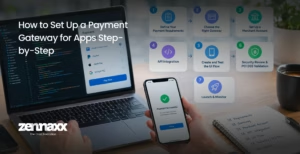
A systematic approach to setting up your payment gateway avoids costly errors, gaps in compliance and rushed security patches later on. Here’s how a professional development team does it.
Step-1 Define Your Payment Requirements
Before you choose a gateway or write a line of code, map out exactly what you need: what currencies, what payment methods, subscription billing vs. one-time payments, refund logic, multi-party payouts (if it’s a marketplace), and what compliance standards apply to your business.
Step-2 Choose the Right Gateway
Assess gateways on Canadian support, fees on transactions, supported payment methods (especially Interac), available APIs and SDKs, quality of developer documentation, PCI DSS compliance certifications. The usual options for Canadian apps are Stripe, Braintree, Moneris, Bambora (now part of Worldline) and Square.
Step-3 Set Up a Merchant Account
To be able to receive money from processed transactions, you’ll need a merchant account either directly with a bank or through a payment service provider (PSP) like Stripe or Moneris.
Step-4 API Integration
Use tokenization to capture card information . Use webhooks to handle events . Use idempotency keys to ensure retry safety . Integrate a payment gateway API into your app’s backend.
Step-5 Create and Test the UI Flow
Design and implement the checkout UI card entry, wallet payment buttons, billing address collection, error states and confirmation screens. Test all happy-path and failure cases in the gateway sandbox environment.
Step-6 Security Review & PCI DSS Validation
Do a full security review before going live validating encryption, tokenization, TLS configuration, API key management and webhook signature verification. Complete the appropriate PCI DSS Self-Assessment Questionnaire (SAQ) for the type of integration you have.
Step-7 Launch & Monitor
Deploy to production and set up real-time monitoring for failed transactions, error rates, webhook delivery failures and any fraud alerts from the gateway. Payment systems require active observation after launch, especially in the first weeks.
Mobile App Payment Integration: Special Considerations
Mobile app payment integration presents its own unique technical and UX considerations that are different from web based payment implementations. For businesses planning a complete mobile application alongside payment functionality, working with an experienced mobile app development company can help ensure that payment flows, security, and user experience are considered from the beginning.
If your app is on iOS or Android, look out for these particular things:
Native Wallet Support
A competitive mobile app can’t afford to not have Apple Pay (for iOS) and Google Pay (for Android) anymore. Both use payment credentials stored on the device and authenticated with biometrics, which makes them faster and more secure than the manual entry of card details and dramatically drives up conversion rates at checkout.
Local Data Processing Security
Mobile devices can be lost or stolen. Do not store card data locally on the device in plain text. Store sensitive tokens in platform secure storage (iOS Keychain, Android Keystore) and implement certificate pinning to prevent man-in-the-middle attacks on API calls.
Direct API vs. SDK
The big gateways usually have native mobile SDKs for iOS (Swift/Objective-C) and Android (Kotlin/Java) to handle the secure card capture flow. And in almost all cases it’s better to use the official SDK than to create your own card capture UI as the SDK is maintained and certified by the gateway provider.
Deep Linking & Return URLs
For redirect-based flows (3DS2, PayPal, Interac Online), the gateway redirects the user to an external page and back to the app. Deep link handling correctly means that users can come back to the right state in your app, rather than a broken screen.
Dealing with Offline & Bad Connectivity
Mobile users can get disconnected during a transaction. Your app must handle network timeouts gracefully, retry logic and ambiguous payment states, displaying accurate, non-alarming messages while safely handling potential double-charge scenarios via idempotency.
Especially in areas like telehealth, where patients might be paying copayments or buying subscription access, the integration of mobile app payments needs to be exceptionally smooth. For context on where payment infrastructure fits into a larger digital health platform, our guide on telehealth software shows how payments, scheduling and clinical tools work together.
Payment Gateway Integration Cost in Canada
The cost of payment gateway integration varies enormously depending on the complexity of your needs, but here’s a realistic framework based on current Canadian market benchmarks:
Development Costs
| Integration Type | Estimates Development Cost (CAD) |
| Basic single-gateway integration (Stripe or Square, card only) | $5,000-$15,000 |
| Mid-range integration (multiple methods, Interac, wallets, recurring billing) | $15,000-$50,000 |
| Enterprise/custom integration (multi-currency, marketplace payouts, custom fraud logic) | $50,000-$200,000+ |
Transaction Fees (Ongoing) Beyond development, there are gateway fees for every payment process. Typical Canadian fee structures:
- Flat-rate pricing: A fixed percentage + small fixed fee per transaction (e.g., 2.9% + $0.30 CAD). Simple and predictable.
- Interchange-plus pricing: The actual interchange rate set by Visa/Mastercard plus a markup. More complex to understand, but often cheaper for high-volume businesses.
- Monthly fees: Some gateways charge a base monthly fee ($25–$100+ CAD) in exchange for lower per-transaction rates.
- Additional fees to budget for: Chargeback fees ($15–$25 per dispute), currency conversion fees (1–3% for non-CAD transactions), and refund processing fees.
Other Cost Factors
- PCI DSS compliance costs- Annual SAQ completion, quarterly vulnerability scans (ASV) and for larger merchants, a Qualified Security Assessor (QSA) audit
- Fraud prevention tools – Advanced fraud scoring, velocity checks and manual review workflows may be subject to additional gateway fees
- Ongoing maintenance – Yearly budget of 10-15% of initial development cost for updates, gateway SDK upgrades and compliance monitoring
Billing software development services that add subscription management, invoicing and automated reconciliation on top of the core gateway integration can add $20,000-$80,000 to your total investment, but dramatically reduces manual billing overhead and payment failure rates.
Security, Compliance & PCI DSS in Canada
Security is not an add-on to a payment gateway integration; it is the architecture on which your entire integration is built. In Canada, payment security is a blend of international standards and domestic regulatory requirements.
If your payment system requires a solution designed around specific business workflows, integrations, and security requirements, consider custom software development services rather than relying entirely on an off-the-shelf platform.
PCI DSS (Payment Card Industry Data Security Standard)
PCI DSS is the worldwide security standard that details the steps any business that accepts, processes, stores or transmits card payment data must take to protect that data. This is not a law specific to Canada, but is enforced by Visa, Mastercard and the card networks themselves. Compliance is an absolute must for any app that processes card payments.
The level of PCI DSS compliance you require will depend on your integration and the number of transactions you process:
- SAQ A- Fully hosted payment pages (lowest scope, easiest to achieve)
- SAQ A-EP- Embedded iFrame/redirect with JavaScript card capture
- SAQ D- Direct API integrations with card data touching your servers (highest scope)
PIPEDA (Personal Information Protection and Electronic Document Act)
Canada’s federal privacy law regulates how companies collect, use and protect personal information, including payment data such as names, addresses and transaction histories. Payment platforms that operate in Canada must have clear privacy policies, data retention limits and breach notification procedures that comply with PIPEDA.
FINTRAC (Financial Transactions and Reports Analysis Centre of Canada)
Some payment-related businesses operating in Canada, particularly businesses providing money transfer or currency exchange services, are required to register with FINTRAC as a Money Services Business (MSB), and meet Canada’s anti-money laundering (AML) and counter-terrorism financing (CTF) requirements.
Key Technical Security Requirements
- All data in transit using TLS 1.2 or higher (TLS 1.3 is highly recommended)
- Card Tokenization for no raw PAN storage
- 3DS2 for strong customer authentication on Card Not Present transactions.
- API key rotation & server-based key storage (never expose API keys in client side code)
- Verify the webhook signature to prevent payment events from being spoofed.
- Security patches and regular dependency updates
Tokenization and point-to-point encryption (P2PE) allow businesses to reduce their PCI DSS compliance scope dramatically, according to the PCI Security Standards Council. These implementation choices are a win for security and for operations, too.
Common Challenges in Payment System Integration (And How to Solve Them)
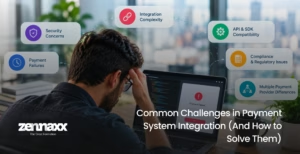
Payment system integration is seldom as simple as just plugging in an API key and leaving it at that. Here are the most common challenges development teams face and how to solve them properly:
High Chargeback Rates
Chargebacks occur when a customer disputes a transaction with their bank. High rates can hurt your merchant account standing and can result in account termination. Use 3DS2 to authenticate the card, keep detailed logs of transactions, use Address Verification Service (AVS) checks and make sure that your product descriptions and billing descriptors are clear to the customers.
Payment Failures
Not all drops are scams. Not enough money, expired cards, wrong billing addresses or overzealous fraud rules are why many are. Build smart decline recovery flows, prompting users to retry with new card details or another payment method. Explore working with your gateway on custom fraud rule tuning.
Multi-Currency & Cross-Border Complexity
Canadian apps with international customers must deal with currency conversion, cross-border processing fees, and tax logic based on jurisdiction. Choose a gateway that offers native multi-currency support beware of dynamic currency conversion (DCC), poorly executed DCC can damage customer trust.
Subscription & Recurring Payment Failures
The silent revenue killer for subscription businesses is failed renewal payments. Reduce involuntary churn by implementing smart retry logic, automatic card update services (most major gateways offer this) and pre-expiry notification flows.
Maintenance Burden of Integration
Change payment gateway APIs. Deprecated SDKs; security standards are updated. A well-built integration today requires ongoing maintenance to remain compliant, secure and functional as the gateway provider evolves their platform. Plan for this from day one.
Pros and Cons of Custom Payment Gateway Integration
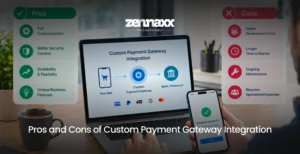
Pros
Full Control Over User Experience
A custom payment platform integration means your checkout flow, error states, confirmation screens and billing management UI feel native to your product, not like a third-party widget bolted on.
Lower Long-Term Costs
Custom integration requires more initial development costs, but it eliminates the ongoing costs of white-labeling or platform licensing fees. Such fees can add up to a lot over time as your business grows.
Flexible Payment Method Support
Custom integrations can support the exact payment methods your Canadian users want Interac, specific wallet providers, PAD for recurring billing, without being constrained by what a pre-built checkout solution supports.
Better Data & Reporting
With direct API integrations, you can access detailed, real-time transaction data and use it in your own analytics, fraud monitoring and reconciliation systems.
Cons
Higher Initial Investment
Custom payment gateway integration involves experienced developers, a proper security architecture and thorough testing all of which cost more up front than a pre-built checkout tool.
Compliance Responsibility
More control. More responsibility. Direct integrations are typically a higher PCI DSS scope and require more rigorous compliance management.
Ongoing Maintenance Required
APIs evolve, libraries become obsolete and security issues are resolved. Custom integrations need active maintenance to keep them current and compliant.
Longer Time to Market
A custom integration could delay the launch for early-stage startups unnecessarily. If you have a well-scoped MVP, an embedded SDK might be a better move initially, and then build out a custom integration as the product matures.
How to Choose the Right Payment Gateway Development Partner

Your payment gateway integration’s quality is greatly dependent on the team building it. Here’s what to look for when choosing a payment gateway software development company:
Proven experience in payment integration
Ask for specific examples of payment gateway integrations they’ve built, which gateways, which countries and which payment methods. Experience with Interac and PIPEDA compliance in Canada is especially valuable.
Security-first development approach
PCI DSS. Tokenization. Webhook security. API key management. These need to be the topics in the very first technical conversation. If not, move on.
Strong API development expertise
Payment integrations live and die at the API level. Your partner needs to have deep experience designing RESTful APIs, handling webhooks, idempotency, and error handling.
For larger projects, businesses may also choose to hire dedicated developers who can work continuously on payment integrations, maintenance, API updates, and other product requirements.
Transparent scoping and pricing
Projects that involve payment integration usually have hidden costs. A good partner offers a detailed scope, milestone-based delivery and transparent cost breakdowns before work begins.
Post-launch maintenance and support
Payment gateways change. You want a partner that will do ongoing maintenance, work on SDK upgrades, and respond to security advisories after your product goes live.
Billing and subscription expertise
If your business model includes recurring billing, subscriptions or usage-based pricing, ask specifically about their experience with billing software development services and subscription management flows.
Zennaxx is a trusted payment gateway software development company with deep expertise in building secure, scalable payment integrations for apps and platforms across Canada including Toronto and Ontario. The team brings together strong API development capabilities, expertise in payment security and comprehensive billing software development services to deliver payment systems that are built to handle real-world complexity from day one.
Whether you are integrating Stripe, Moneris, Bambora or building a custom payment layer with Interac support and multi-currency capabilities, Zennaxx has the experience to get it right.
Final Thoughts
Payment Gateway Integration is one of the most crucial technical decisions a Canadian app or software company makes. When done well, it creates a seamless, trustworthy payment experience that converts users, retains customers, and scales as you grow. When done poorly, it becomes a source of failed transactions, security vulnerabilities, chargeback headaches and compliance risk.
The good news is that nailing it is entirely achievable with the right architecture decisions, the right gateway selection and the right development partner, whether you’re launching your first app in Toronto or scaling an enterprise platform across Ontario and beyond.
Zennaxx is a payment gateway software development company that creates secure and scalable payment integrations for Canadian businesses. From API development to payment gateway integration and ongoing billing software development services, our team delivers payment systems that perform reliably on day one and continue to perform as your business grows.
FAQs
What Is the Best Payment Gateway for Apps in Canada?
It’s very much going to depend on your use case, your volume, and what payment methods you need. Stripe is developer-friendly and well supported. Moneris offers the best Interac coverage in Canada. Bambora is a good fit for businesses who need local acquisition. Braintree is good for marketplaces. Square is great for apps in retail or food service. Browse through our list of the top payment gateways in Canada or work with an expert payment gateway software development company to find the right fit for you.
How Much Does Payment Gateway Integration Cost in Canada?
A simple single-gateway integration is usually anywhere from $5,000 to $15,000 CAD. Intermediate integrations (Interac, Apple Pay, Google Pay, recurring billing) $15,000 – $50,000 CAD Enterprise builds, multi-currency, custom fraud logic, can go over $200k CAD. Development Costs + Transaction Costs (1.5%-3%) PCI DSS Compliance and Yearly Maintenance.
Is Stripe Available in Canada, and Does It Support Interac?
Yes. Stripe is fully supported in Canada and supports Visa, Mastercard, Amex, Apple Pay and Google Pay. Supported by Interac. If you want Interac Debit at checkout, compare Stripe with Moneris or Bambora before you sign up.
What Is PCI DSS Compliance, and Do I Need It for My App?
Yes, if your app processes card payments, then you must comply with PCI DSS. SAQ A are for hosted redirect pages. SAQ A-EP is for SDK capture embedded. SAQ D is for direct API integrations. Depending on the type of integration you have, the amount of completion you will need to do will vary. Your best friends to reduce your compliance scope are tokenization and hosted card capture.
How Long Does It Take to Integrate a Payment Gateway Into an App?
Rapid integration within 2-4 weeks Average 4-8 weeks for a mid-range build with Interac, wallets and subscription billing. For enterprise integrations with custom fraud logic and multi-currency support, it can take 3-6 months. Security reviews and PCI DSS validation take time and should not be skipped on any project.