Mental Health App Development: Ultimate Guide to Cost, Features, Compliance and Process

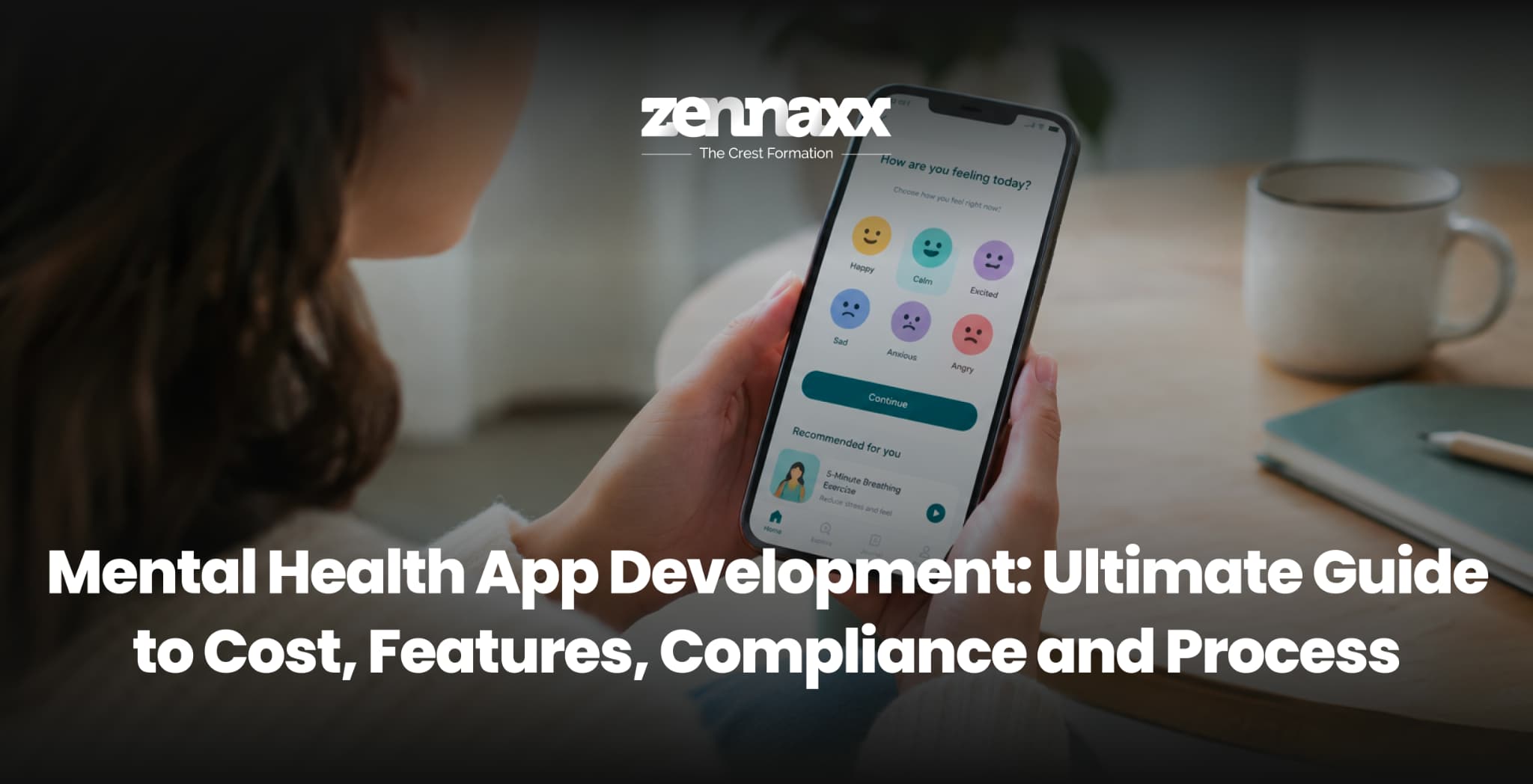
Why You Should Invest in Mental Health App Development in 2026
The conversation around mental health is no longer kept secret. It is one of the most important global health priorities of our time and the digital health industry has responded with decisiveness.
The global mental health applications market size is projected to reach USD 33.7 billion by 2034, growing at a CAGR of 17.6% during the forecast period 2026 to 2034. That growth is fueled by more awareness, a global shortage of mental health professionals and the growing willingness of people, especially younger generations, to seek help through digital channels. According to Grand View Research, North America remains the dominant region for mental health app adoption, with 55% of Gen Z and Millennials reporting they’ve used a mental health app in the past year.
The supply side tells a similar story. Canada faces a well-documented access crisis with waitlists for therapy stretching months in Ontario and beyond. Mental health apps bridge the gap meaningfully, giving people structured support between sessions, on-demand coping tools, and direct access to licensed therapists without friction of in-person scheduling.
Digital mental health tools have delivered up to a 91% reduction in care delivery costs compared to traditional therapy making the business case as compelling as the clinical one. For healthcare businesses, startups, clinics, employee wellness platforms and health tech entrepreneurs, mental health app development represents one of the most impactful and commercially viable opportunities in digital health today.
Types of Mental Health Apps You Can Build
Mental health applications aren’t one-size-fits-all. The category spans a wide range of use cases, clinical depths and user populations. Before development begins, it’s important to define exactly what kind of platform you’re building because features, compliance requirements and development complexity vary significantly by type.
Teletherapy & Online Counseling Platforms
These connect patients with licensed therapists or psychiatrists via secure video, audio or text-based sessions. They carry the highest compliance requirements and clinical responsibility but also the deepest clinical value.
Mood Tracking and Journaling Apps
Apps that assist users in monitoring their emotional states, identifying patterns over time and fostering self-awareness of mental health triggers. Often the foundation of broader mental wellness platforms is lighter on compliance, but high on daily engagement potential.
Meditation & Mindfulness Apps
Guided meditation sessions, breathing exercises, sleep stories and stress-reduction content. Lower clinical complexity, high consumer appeal. Platforms like Calm and Headspace have proven the category at scale.
Cognitive Behavioral Therapy (CBT) Apps
Evidence-based apps that deliver CBT exercises, thought records and behavioral activation tools either as standalone products or as supplements to in-person therapy. Growth in clinical adoption as evidence for digital CBT continues to accumulate.
Community Platforms And Peer Support
Safe, moderated communities where users share experiences and connect with others facing similar mental health challenges. Requires careful moderation architecture and protective protocols.
Substance Use & Addiction Recovery Applications
Specialized platforms providing soberness tracking, access to 12-step community, crisis intervention, and access to recovery coaches or counselors.
Employee Mental Wellness Platforms
B2B-focused platforms sold to employers as a workplace benefit employer-funded models are one of the fastest growing segments in 2026, creating sustainable recurring revenue while eliminating direct-to-consumer acquisition costs.
Understanding which type of mental health software you’re building shapes every decision that follows from feature selection and tech stack to compliance obligations and monetization strategy.
Must Have Features of a Mental Health App
The features that make a mental health app genuinely useful are different from those that make most consumer apps successful. In this space, trust, safety and clinical grounding matter as much as visual design and smooth UX. Here are the features every serious mental wellness app development projects should include:
Personalized Onboarding & Assessment
A thoughtful onboarding flow asking about goals, current challenges and mental health history lets the platform personalize the experience from day one and route users toward the most relevant support.
Secure Video & Audio Therapy Sessions
For any platform connecting users with therapists, HIPAA-compliant (or PIPEDA-compliant for Canada) video calling is non-negotiable. End-to-end encryption, session recording consent management and reliable low-latency video are all required.
Mood Tracking & Journaling
Daily or on-demand mood logging with visualizations showing patterns over time is one of the highest engagement features in any mental health mobile app development project. It gives users visible progress and gives clinicians valuable longitudinal data.
Chatbot & Crisis Support Powered by AI
Conversational AI is able to offer support when human therapists are not available by helping users through breathing exercises, CBT techniques or grounding exercises during moments of distress. The clear escalation path to human support or emergency services for users in crisis is critical.
Therapist Matching & Scheduling Appointments
Intelligent therapist matching based on specialty, availability, and user preferences, combined with real-time scheduling and automated reminders removes the biggest friction point in accessing professional mental health care.
Exercise Library for CBT & DBT
Even outside of scheduled therapy sessions, a structured library of evidence-based exercises, thought records, behavioral activation tools, mindfulness scripts and distress tolerance techniques offers clinical value.
Progress Tracking & Reporting
Seeing dashboards with mood trends, exercises completed, session history, and wellness milestones helps people feel a sense of accomplishment and supports clinical conversations with therapists.
Emergency Contact & Crisis Resources
Every mental health application must have a clearly accessible crisis pathway crisis hotline numbers, emergency contact protocols and location-aware emergency services links. This is both a clinical responsibility and increasingly a regulatory expectation.
Wearable & Health Data Integration
Connecting with Apple Health or Google Fit to incorporate sleep quality, heart rate variability and activity data enriches the picture of a user’s mental wellbeing and enables more personalized interventions.
A well-designed healthcare app architecture brings all of these features together into a coherent, clinically sound experience, something covered in depth in the healthcare app development.
Advanced Technologies Shaping Mental Wellness App Development
The most impactful mental health software development projects in 2026 aren’t just digitizing existing therapy, they’re using technology to deliver genuinely new forms of mental health support. Here’s what’s driving the next generation of platforms:
Artificial Intelligence & Machine Learning
AI is transforming mental health apps across three-layers: personalization (delivering the right content at the right moment), prediction (identifying users at risk of deterioration based on usage patterns and mood data) and automation (powering conversational therapy bots that provide CBT-based interventions around the clock). Passive mood detection from device usage patterns and AI-personalized CBT delivery are no longer experimental; they’re entering production in leading platforms today.
Natural Language Processing(NLP)
NLP enables apps to analyze the language users use in journals, messages and chatbot conversations identifying sentiment shifts, detecting distress signals and surfacing clinical insights that would be impossible to spot manually.
Wearable and Biometric Integration
Smartwatches and biosensors can measure physiological stress markers, increased heart rate, poor sleep, decreased activity that correlate with deteriorating mental health. Bringing this data together gives a fuller, more objective understanding of wellbeing in addition to the subjective mood reports.
Exposure Therapy and Augmented Reality (AR)
AR is showing promising results in treatment of anxiety and phobia, providing a controlled graduated exposure to feared situations in a safe digital environment without the cost and logistics of traditional in-vivo exposure therapy.
Telepsychiatry & Prescribing Integration
The newest frontier platforms that connect users not just with therapists but with licensed psychiatrists who can conduct digital evaluations and manage prescriptions, including controlled substance prescribing under applicable regulations.
Mental Health App Development Process: A Step-by-Step Guide
Creating a safe, effective and scalable mental health app requires a structured, clinical-grade development process. Cutting corners at any stage and especially in compliance and clinical validation poses a serious risk for both users and the business.
Phase 1: Discovery and Clinical Validation
First, a deep dive into research: defining the target user population, mapping clinical workflows, reviewing regulatory requirements and identifying the evidence base for the intervention the app will deliver. For apps that make therapeutic claims, early feedback from licensed clinicians is essential.
Phase 2: UX / UI Design
Mental health apps have their own responsibilities. Interfaces need to be low friction and not overwhelming, warm and approachable, not clinical and sterile. User accessibility for those with anxiety, depression or cognitive impairment needs to be throughout.
Phase 3: Building the MVP
The right approach for almost every mental health app development project is to launch with core features first, mood tracking, one support format and a basic dashboard before adding AI chat or full teletherapy. Starting lean gives teams a chance to test clinical assumptions and user engagement patterns with real users before committing to full-scale feature development. MVP development process is particularly suitable for digital health products where user behavior can be unpredictable in advance.
Phase 4: Create Compliance Architecture & Security
HIPAA (for US users), PIPEDA/PHIPA (for Canadian users) and GDPR (for European users) are built into the architecture during development, not added afterward. This includes encryption, control of access, audit logging and data retention policies. The compliance considerations here are very similar to those discussed in EHR software development where security architecture is similarly foundational.
Phase 5: Clinical Testing and User Research
Clinical validation and user testing identify usability and safety issues before the public launch. This phase is especially important for mental health software. An anxiety-inducing app, one that confuses users in distress, or one that doesn’t clearly surface crisis resources, can do real harm.
Phase 6: Launch and Ongoing Iteration
What separates a successful platform from one that is abandoned is post launch analytics, clinical outcome measurement, and regular feature iterations based on user feedback. Mental health apps don’t live or die on downloads, but on consistent use.
Mental Health App Development Cost: Realistic Breakdown
Building a mental health app usually costs between $40,000 and $250,000+ depending on the complexity of features, platform targets, compliance requirements, and the skill of the development team. Here’s a realistic breakdown for the Canadian market:
Cost by Development Tier
| Tier | What’s Included | Estimated Cost (CAD) | Timeline |
| MVP | Mood tracking, journaling, basic content library, user accounts | $50,000 – $90,000 | 10-14 weeks |
| Mid-Range | Teletherapy, therapist matching, AI chatbot, wearable integration | $100,000 – $200,000 | 4-7 months |
| Enterprise | Full platform with AI, prescribing, employer portal, multi-region compliance | $200,000 – $400,000+ | 8-14 months |
Key Cost Drivers
- Compliance architecture – HIPAA, PIPEDA, PHIPA, and GDPR requirements add significant engineering overhead to any build
- Video calling infrastructure – HIPAA-compliant encrypted video at scale requires specialized infrastructure investment
- AI and NLP features – Mood detection, AI chatbots, and sentiment analysis add both development cost and ongoing compute cost
- Platform targets – Building native apps for both iOS and Android separately costs more than cross-platform, but delivers superior performance and native feature access
- Third-party integrations – EHR integrations, pharmacy connections, insurance verification, and wearable APIs each add scope
- Content development – CBT exercise libraries, meditation content, and clinically reviewed wellness material require separate investment beyond software
Ongoing Costs to Budget For
- HIPAA-compliant cloud hosting: $300–$3,000+ CAD per month
- Security audits and penetration testing: $5,000–$30,000 annually
- App store fees and maintenance: 15–20% of initial development cost annually
- Clinical content review and updates: Variable based on content volume
Building an MVP first is almost always the right approach; it validates the clinical model, proves user engagement, and attracts investment before a full-scale build commitment.
Compliance & Security in Mental Health Software Development

Mental health data is among the most sensitive personal information that exists. A breach involving therapy session notes, psychiatric diagnoses, or substance use history carries profound personal consequences for the individuals affected and severe legal and reputational consequences for the platform responsible.
Compliance in mental health software development must be treated as architecture from day one, not a checkbox added at the end.
Major Compliance Frameworks
- HIPAA (US) – Required for any platform that processes Protected Health Information (PHI) for US users. Addresses encryption, control of access, breach notification and Business Associate Agreements with all vendors touching PHI.
- PIPEDA & PHIPA (Canada) – PIPEDA is the federal privacy law in Canada and PHIPA is the health-specific law in Ontario governing the collection, use and disclosure of personal health information.
- GDPR (EU) – For platforms that target European users, stringent requirements around data minimization, consent, and the right to deletion.
- SOC 2 Type II – Increasing demand from enterprise purchasers — employers, insurers, and health systems – purchasing mental health platforms as a benefit to the workplace.
Non-Negotiable Technical Security Requirements
- AES-256 encryption for all data at rest
- TLS 1.3 for all data in transit
- End-to-end encryption for therapy session audio, video, and messaging
- Multi-factor authentication (MFA) for all provider and admin accounts
- Role-based access control (RBAC) with comprehensive audit logging
- Automatic session timeouts
- Regular penetration testing and third-party security audits
- Secure data deletion protocols for account closures
A Critical Note on Mental Health Data
Unlike general health data, mental health records carry additional sensitivity. In Canada, many provinces have specific provisions restricting the disclosure of mental health and addiction records even more tightly than general health information. According to the World Health Organization, stigma and privacy concerns remain the primary barriers to help-seeking which means data protection isn’t just a compliance requirement, it’s a core product promise to your users.
Platforms that include teletherapy components face the same security architecture decisions that apply to any digital health care delivery tool; the telehealth software development guide covers these in detail for teams building connected care experiences.
Monetization Strategies for Mental Health Apps
A technically excellent mental wellness app still needs a sustainable business model. Here are the monetization approaches that are working in 2026:
Subscription (B2C)
Monthly or annual subscriptions giving users access to premium content, unlimited therapy sessions, or advanced features. The dominant model for consumer-facing apps. Works best when the free tier offers genuine value and the premium tier delivers clear clinical benefit.
Freemium
A free base experience with paid unlocks for premium features AI-guided CBT, live therapy sessions, personalized programs. Lower acquisition barrier, but requires careful design to ensure the free experience doesn’t feel incomplete.
B2B / Employer-Funded
Selling platform access as an employee benefit, with the employer paying a per-seat fee. One of the fastest-growing models in the sector — it dramatically reduces consumer acquisition cost and creates predictable recurring revenue, but requires strong clinical outcomes reporting to close enterprise deals.
Insurance Billing & Reimbursement
Teletherapy platforms employing or credentialing licensed therapists can bill sessions directly to insurance providers including through provincial health insurance plans in Canada for covered mental health services. Highest revenue per session, but the most operationally complex model to run.
One-Time & In-App Purchases
This is less common on clinical platforms but relevant in meditation apps and niche wellness programs where users prefer a single purchase over recurring commitment.
Pros and Cons of Mental Health App Development
Pros
24/7 Accessibility- While in-person therapy is constrained by clinic hours, location, and therapist availability, mental health apps provide support whenever you need it, no matter where you are. This is especially helpful when dealing with late-night anxiety attacks, or in places where provider access is limited.
Reduced Stigma Barrier- Many who would never walk into a therapist’s office will open an app. Mobile apps are private and judgment-free, and lower the barrier to help-seeking for those who feel shame or fear around help-seeking.
Scalability- A well-built mental wellness platform can cater to hundreds of thousands of users simultaneously, something no human therapist network can emulate. This allows mental health problems to be addressed at a population level.
Longitudinal Data for Better Care- Rich longitudinal datasets are created from daily mood logs, journal entries, and engagement patterns, giving users and clinicians unprecedented visibility into mental health trajectories over time.
Cost-Effective Support- Digital mental health tools have delivered up to a 91% reduction in care delivery costs compared to traditional therapy making support accessible to people who can’t afford private therapy rates.
Cons
Cannot Replace Human Clinical Care- For serious mental health conditions clinical depression, bipolar disorder, schizophrenia, active suicidality apps are support tools, not replacements for professional diagnosis and treatment. Building clear clinical referral pathways is both a legal and ethical responsibility.
Engagement & Retention Challenges- Retention in the mental health app category is notoriously difficult; many users download apps during a crisis and disengage once the immediate distress passes. Sustainable engagement requires ongoing content investment and thoughtful product design.
High Compliance Complexity- The sensitive nature of data categories, diverse regulations, and clinical responsibility make compliance in this space more challenging than most other app categories.
Content Quality Risk- Poorly designed or clinically unvalidated content can be actively harmful to users by reinforcing negative thought patterns, triggering distress, or fostering dependency. Clinical review of content is non-negotiable.
How to Choose the Best Mental Health App Development Company
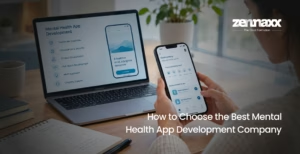
Choosing the right mental health app development company is one of the most consequential decisions in this process. This is a domain where general-purpose app development experience is simply not enough. Here’s what to look for:
Healthcare domain expertise – The team should have an understanding of the clinical workflows, compliance requirements and the specific UX considerations for vulnerable user populations. Ask for case studies from healthcare or digital health projects specifically.
Compliance-first architecture – HIPAA, PIPEDA, PHIPA, GDPR these should come up in the very first technical conversation. A team that treats compliance as an afterthought will cost you significantly more in remediation later.
Clinical consultation capability – The best mental health app developers have relationships with licensed clinicians who can review content, validate clinical assumptions, and contribute to a responsible product design process.
Full-stack capability – Mental health platforms require backend API development, HIPAA-compliant cloud infrastructure, native iOS and Android mobile development, and sophisticated frontend UX design all from one coordinated team.
MVP-first approach – A partner who suggests starting with a Minimum Viable Product (MVP) instead of jumping straight into a full-scale build shows they have both business acumen and a genuine insight into how successful digital health products are created.
Transparent pricing and ongoing support – Mental health software needs ongoing maintenance, compliance monitoring, content updates, and security patching. Pick a partner that’s built for the long haul, not just the launch.
As a trusted mobile app development company and specialized healthcare app development company, Zennaxx offers end-to-end mental health app development services from discovery and UX design to compliance validation, launch and ongoing support. If you are a healthcare startup in Ontario, a mental health clinic scaling up digitally, or an employer building a wellness platform for your team, the depth of healthcare compliance expertise and clinical sensitivity the team brings makes a measurable difference on what gets built.
Final Thoughts
The development of mental health apps is in a uniquely important space where technology meets some of the most vulnerable and important moments in people’s lives. Getting it right is not only about good code. It takes clinical thinking, compliance rigor, empathetic design, and a development team that genuinely understands the responsibility involved.
The market opportunity is real and growing fast. The global mental health apps market is projected to surpass $41 billion by 2035 and the organizations building trustworthy, clinically grounded platforms today will be the ones leading that market for the next decade.
Whether you’re launching your first mental health platform or scaling an existing one, the quality of your development partner will shape the outcome more than any single feature or technology choice.
FAQs
How much does it cost to develop a mental health app?
The price generally falls between $40,000 and $250,000+ CAD, depending on features, platform and compliance requirements. A basic MVP will start at ~50k. Mid-range platforms with teletherapy and AI features are $100k-$200k. Enterprise builds can top $400,000. The total lifecycle cost includes compliance infrastructure, HIPAA compliant hosting, and ongoing maintenance.
How long does it take to build a mental health app?
Basic MVP will take 10-14 weeks. Mid-range platform normally takes 4-7 months. A full enterprise-grade build with AI capabilities, multi-region compliance, and EHR integrations takes 8-14 months. The biggest time variable is getting the compliance architecture right from the beginning, and retrofitting it is much more expensive.
Do mental health apps need to be HIPAA compliant?
Yes, if your app handles any Protected Health Information (PHI) for US users, HIPAA compliance is required. For Canadian users, PIPEDA and provincial laws such as PHIPA (Ontario) apply. Mental health data is especially sensitive, and penalties for non-compliance can run into the millions of dollars per category of violation per year.
What are the must-have features of a mental health app?
Personalized onboarding and mood assessment Secure video/audio therapy sessions Mood tracking and journaling AI chatbot with crisis escalation Therapist matching and appointment scheduling CBT/DBT exercise library Progress tracking dashboards Push notifications Peer support community Accessible crisis resource links Advanced platforms include wearable data and AI-driven personalization.
Can AI replace therapists in mental health apps?
No, and shouldn’t try to. The best use of AI is as a support layer. It can deliver CBT exercises, detect trends in moods, provide 24/7 coping tips and identify users who may need urgent human support. Licensed human clinicians are no substitute for diagnosis, treatment planning and therapeutic relationships. The best mental health apps marry the scalability of AI with the clinical depth of human care.