Nearshore vs Offshore Development for Canadian Companies


Canadian businesses are rethinking how they build software. Rising local salaries, a tight domestic talent market, and growing project complexity have pushed more companies to look beyond their own borders for development support. The decision usually comes down to one core question: should you go nearshore or offshore?
This guide breaks down nearshore vs offshore development in plain language, compares the two models side by side, and shows Canadian companies how to choose the right path, whether that means partnering with a software development outsourcing company, building a hybrid in-house and external team, or exploring other software outsourcing models altogether.
By the end, you will understand the cost differences, time zone impact, cultural fit, and the practical steps to pick a partner that fits your business goals, not just your budget.
What Is Nearshore Software Development?
Nearshore development means hiring a software team in a country that is geographically close and shares a similar, or fully overlapping, time zone. For Canadian companies, nearshore partners are typically based in the United States, Mexico, Costa Rica, Colombia, Brazil, or other Latin American countries.
The appeal is straightforward: you get meaningful cost savings compared to hiring locally, without the steep learning curve of coordinating across a 10 to 12 hour time difference. Teams can join daily stand-ups, respond to urgent requests within business hours, and build the kind of working relationship that is harder to maintain across continents. For many Canadian founders and CTOs, this makes nearshore development feel like an extension of the in-house team rather than an outsourced function.
What Is Offshore Software Development?
Offshore development, by contrast, means partnering with a team located far away, often in a different time zone altogether, such as South Asia, Eastern Europe, or Southeast Asia. Countries like India, Poland, Ukraine, Vietnam, and the Philippines have become go-to hubs for the offshore software development Canada companies increasingly rely on for large-scale, cost-sensitive projects.
The biggest draw of offshore outsourcing is cost. Labor rates in popular offshore destinations are often significantly lower than in Canada or nearshore locations, and the sheer size of the talent pool makes it easier to scale a team quickly. The trade-off is less overlap in working hours, which can slow down real-time collaboration if the engagement is not managed well from the start.
Why This Decision Matters More Than Ever for Canadian Companies
Outsourcing is not a fringe strategy anymore, it is mainstream business infrastructure. As CIO.com’s breakdown of outsourcing notes, IT and software outsourcing has moved well beyond simple cost-cutting into a core part of how technology leaders close skill gaps and manage delivery capacity. For Canadian companies competing with larger U.S. and global players for the same limited pool of local developers, that shift makes outsourcing less of an experiment and more of a competitive necessity.
Nearshore vs Offshore Software Development: Key Differences
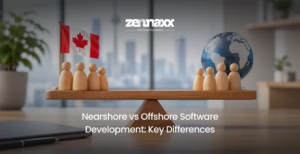
Choosing between nearshore vs offshore software development is not about picking a better model, it is about matching the model to your project, budget, and communication needs. Here is how the two compare across the factors that matter most.
Time Zone Overlap & Communication
This is often the deciding factor. Time zone overlap outsourcing allows Canadian teams to collaborate with developers during normal business hours, which means faster feedback loops, quicker bug fixes, and fewer late-night calls. As TechTarget’s definition of nearshore outsourcing explains, the model exists specifically to keep teams working inside compatible hours rather than relying on the handoff-and-wait cycle that distant offshore engagements often fall into.
Offshore teams can absolutely deliver excellent work, but they typically lean more heavily on asynchronous communication: detailed documentation, recorded updates, and structured handoff notes, rather than live back-and-forth conversation.
Cost Structure & Budget Impact
Offshore development usually wins on raw hourly rates. Developers in established offshore hubs can cost roughly 50 to 70 percent less than Canadian developers, while nearshore rates tend to land somewhere in between, lower than hiring locally, but somewhat higher than offshore. That said, cost is not only about the hourly rate on paper. Rework caused by miscommunication, project delays, and added management overhead can quietly erode the apparent savings of an offshore engagement if the partnership is not structured and managed carefully from day one.
Cultural Fit & Language
Nearshore partners, especially those in the Americas, tend to share closer cultural and business norms with Canadian companies, along with strong English, and often French, proficiency. Offshore partners can also offer excellent English skills, particularly in established hubs like India and the Philippines, but cultural nuances around feedback style, hierarchy, and decision-making pace can take longer to align, especially on fast-moving projects.
Talent Pool & Scalability
Offshore markets generally offer a larger, more specialized talent pool, which makes them attractive for big or highly technical projects that need niche skills fast. Nearshore markets are growing quickly too, particularly across Latin America, but the pool, while skilled, is comparatively smaller. A hybrid onshore offshore team lets you tap into both worlds: core strategic work handled close to home, with offshore talent brought in to add scale and speed.
Data Security & Risk Management
Both models can be secure when the right contracts and processes are in place, but the due-diligence process differs. Nearshore partners operating under similar legal frameworks to Canada and the U.S. can simplify data-handling and compliance conversations, while offshore partners may require more detailed security audits, clearer data-residency clauses, and stronger NDAs, particularly for companies handling regulated or sensitive customer data under Canadian privacy law.
Why Canadian Companies Are Turning to Offshore Software Development Canada Businesses Trust
Canada’s tech talent market is tight, and local developer salaries have climbed steadily over the past few years. That has pushed a growing number of businesses toward offshore software development Canada providers to stretch budgets further without compromising on delivery quality.
It is not just startups either. Mid-size and enterprise companies are increasingly treating offshore partnerships as a long-term resourcing strategy rather than a short-term fix, using it to launch MVPs faster, extend in-house engineering capacity, and access specialized skills, like AI integration or cloud architecture, that are in short supply locally.
Done right, this is not about replacing a Canadian team, it is about extending it, which is why more companies carefully compare in-house vs outsourced development before committing to a single resourcing model for the long haul.
The Hybrid Onshore Offshore Team: Best of Both Worlds
A growing number of Canadian businesses are not choosing nearshore or offshore exclusively, they are building a hybrid onshore offshore team instead. In this model, a core team based in Canada, or a nearby nearshore location, handles strategy, client communication, and sensitive decision-making, while an offshore team manages development at scale, testing, or routine maintenance work.
This structure gives companies the best of both worlds: real-time oversight where it matters most, and cost-efficient scale where it does not. It also reduces risk, because if one part of the team faces a delay or turnover, the rest of the operation keeps moving without a full stop.
Why Time Zone Overlap Outsourcing Matters for Canadian Businesses
Time zone overlap outsourcing is not just a nice-to-have, for projects with tight deadlines, live product issues, or frequent client check-ins, it can determine whether a partnership succeeds or stalls. When your development team’s working hours overlap with yours by even four to six hours, you get same-day answers instead of 24-hour delays on every question.
This is exactly why nearshore destinations like Mexico, Colombia, and Costa Rica have become so popular with Canadian companies. Eastern and Pacific business hours overlap closely with most of Latin America’s working day, making daily stand-ups and sprint reviews far easier to coordinate than with teams in Asia or Eastern Europe.
That said, offshore engagements can still work well for projects that do not require constant live collaboration, think long-term development cycles, QA testing, or backend work that can progress independently with periodic check-ins rather than real-time coordination.
How to Choose the Right Software Development Outsourcing Company

Picking the right software development outsourcing company, nearshore or offshore, comes down to a few practical checks:
- Portfolio and technical depth: Look for proven experience in your tech stack and industry, not just a long client list.
- Communication process: Ask how they run stand-ups, sprint planning, and reporting, and whether their working hours genuinely overlap with yours.
- Security and compliance: Especially important for Canadian companies handling sensitive data under provincial and federal privacy regulations.
- Scalability: Can the team grow or shrink with your project without a long onboarding delay each time?
- References and reviews: Speak to past clients about how the partner handled scope changes, delays, or disagreements, not just the wins.
It is worth reviewing common software outsourcing models, staff augmentation, dedicated teams, and project-based outsourcing, before signing a contract, since the right engagement model can matter just as much as the right country.
Benefits of Partnering With Software Outsourcing Companies in Canada
Working with established software outsourcing companies in Canada, companies that manage nearshore and offshore delivery on your behalf, gives Canadian businesses a few clear advantages:
- Local account management with direct accountability under Canadian business norms
- Easier alignment with Canadian data and privacy requirements
- A single point of contact coordinating distributed talent across multiple time zones
- Faster vendor vetting, since the heavy lifting of finding and managing offshore or nearshore talent is already done for you
Choosing an experienced outsourcing software development company also means you are not starting from scratch on process. They have already built the playbooks for distributed collaboration, QA, and delivery that take most in-house teams years to refine on their own, and their software development outsourcing services are typically structured to flex around your budget and timeline rather than forcing a rigid engagement model.
Common Mistakes to Avoid When Outsourcing Software Development
Even strong outsourcing partnerships can go sideways without the right groundwork. Some of the most common pitfalls include unclear project scope, underestimating the importance of documentation, picking a vendor on price alone, and skipping reference checks before signing. A closer look at common software outsourcing mistakes can help you avoid the missteps that quietly derail otherwise promising partnerships before they even get off the ground.
Nearshore vs Offshore Development: Which Model Is Right for Your Business?
There is no universal answer to the nearshore vs offshore development question, the right fit depends entirely on your priorities.
Choose nearshore if real-time collaboration, cultural alignment, and faster turnaround on feedback matter most to your project, especially for product development that needs close, frequent coordination with your in-house team.
Choose offshore if your top priority is cost efficiency and you are working on a project that can progress with less day-to-day, real-time interaction, such as long-term platform builds, QA automation, or backend modernization work.
Many Canadian companies land somewhere in between, using a hybrid model that blends nearshore collaboration with offshore scale, proof that this does not have to be an either-or decision at all.
Frequently Asked Questions
What is the main difference between nearshore and offshore software development?
Nearshore development uses a team in a nearby country with overlapping time zones, while offshore development uses a team in a distant country, often with little to no time zone overlap.
Is nearshore or offshore cheaper for Canadian companies?
Offshore development is typically cheaper on an hourly basis, while nearshore development costs more than offshore but less than hiring locally in Canada, with the added benefit of easier real-time collaboration.
What countries are popular for nearshore outsourcing from Canada?
Mexico, Costa Rica, Colombia, Brazil, and the United States are among the most common nearshore destinations for Canadian companies, largely due to strong time zone overlap.
Can a company use both nearshore and offshore teams together?
Yes. A hybrid onshore offshore team model is increasingly common, combining nearshore or in-house talent for strategy and communication with offshore talent for cost-efficient scale.
How do I know if my project is better suited to nearshore or offshore outsourcing?
Projects that need frequent, real-time collaboration usually suit nearshore teams, while projects that can progress independently with periodic check-ins are often a good fit for offshore teams.