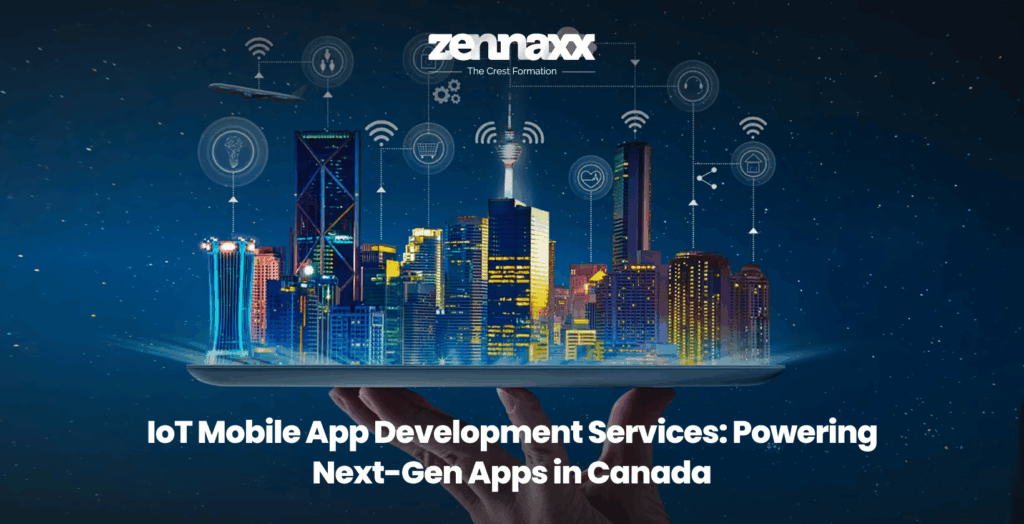
A fitness tracker that logs steps and a mobile app governing a home thermostat are everyday examples of IoT mobile apps. In smart homes to healthcare, industrial automation to fleet management, IoT mobile applications redefine the experience of communication between technology and us.
Do you know there is intelligent orchestration behind this invisible user experience? It is an IoT ecosystem that consists of physical devices, processing logic, and mobile applications that provide the user interface for interactions.
In this blog, we are going to explore IoT mobile app development services in Canada and the importance of choosing the right development partner.
What Are IoT Mobile Applications?
IoT mobile applications are user-centered interfaces connecting smart devices, cloud systems, and end-users. Using these apps, users can monitor, control, and interact with connected devices in real time.
IoT devices send data over networks such as Wi-Fi or Bluetooth. The mobile apps then display this data on user interfaces after processing the received data. The end user can then adjust settings remotely, get notification alerts, or view real-time device insights on their smartphone.
The IoT mobile app development services play a major role in making sense of the vast IoT data to give users seamless control of their connected ecosystem.
Let’s look at the top use cases where IoT mobile apps are used in the world.
IoT Mobile App Use Cases Across Industries in Canada
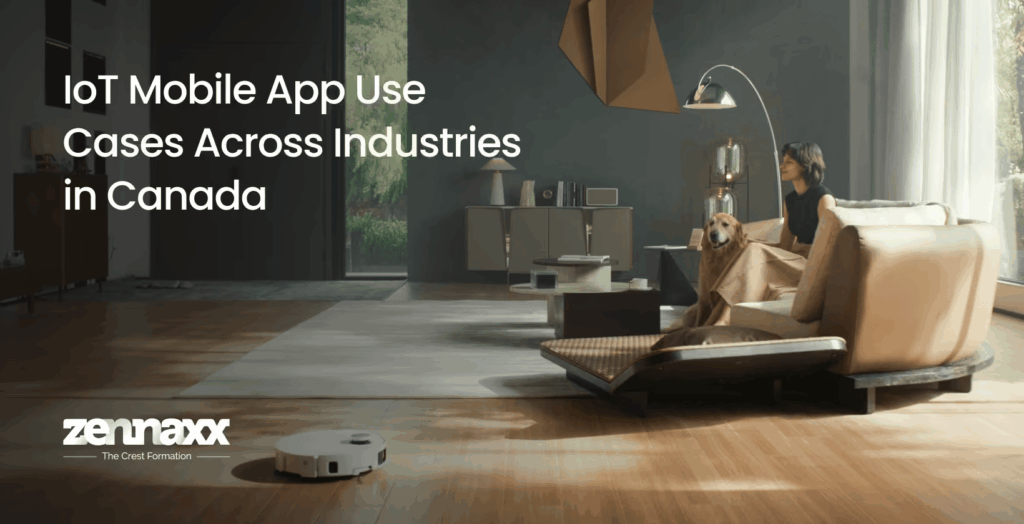
Here are some of the examples where IoT apps are used in the real world:
- Smart Homes: IoT connects home devices like lighting, security, appliances, and climate control. Users get convenience and safety when they can control their home with a few taps on their smartphone.
- Remote Patient Monitoring: When patients wear wearable devices, they collect data like heart rate, blood pressure, and glucose levels. These provide continuous patient monitoring and send alerts to the doctors for critical conditions. The doctors can remotely monitor patient status and intervene quickly when needed.
- Manufacturing: RIoT sensors monitor equipment performance, detect faults, and provide real-time production analytics. From the mobile apps, supervisors and managers can monitor device usage and schedule maintenance.
- Transportation: Telematics systems, along with IoT, track vehicle location, driver behavior, fuel usage, and route optimization that are easily viewed using mobile applications for the fleet controller to monitor and take necessary actions.
While IoT is used in the real world for the above-mentioned and many other use cases, the development of mobile apps involves connecting with several layers of technology.
Core layers of an IoT mobile application architecture
IoT architectures are built around the following key layers that define how devices connect, communicate, process data, and interact with users:
- Device and sensor layer: Also called the physical or perception layer, at this layer, the IoT devices collect data from their environment using sensors or actuators.
- Connectivity and protocol layer: This is the network layer that transmits data between devices and processing systems.
- Data processing layer: IoT data is converted into meaningful analytics in this layer, where analysers, filters, and interpreters make sense of the IoT data to derive insights.
- Mobile application layer: This layer is visible to the end user as it delivers user interfaces like mobile apps, dashboards, and services, and allows users to interact with the underlying IoT systems.
Now that we know the core layers, let’s explore the entire IoT mobile app development process.
How IoT Mobile App Development Works – End-to-End Process
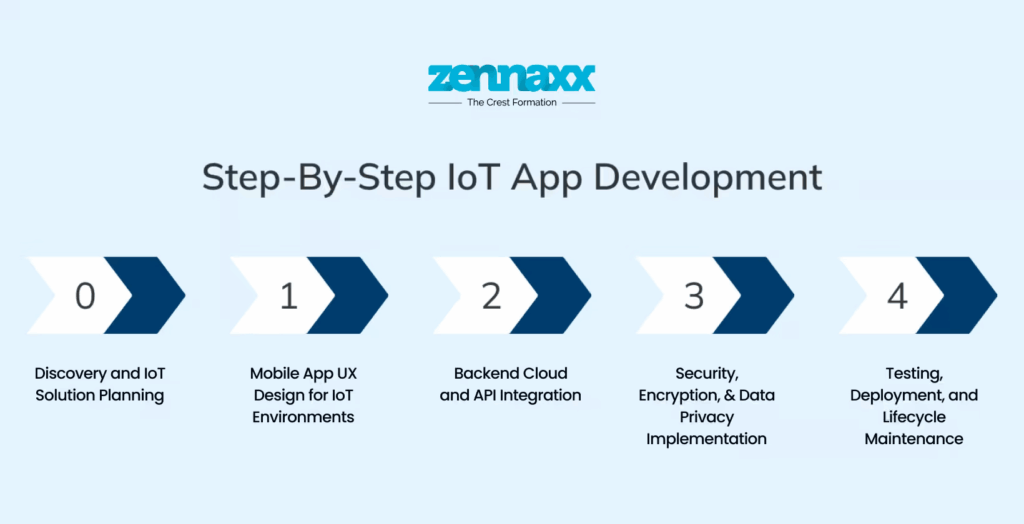
Developing an IoT mobile app is different from creating a typical mobile application. It involves synchronizing hardware, connectivity, cloud services, and mobile interfaces into a unified workflow. A mobile app development company Canada follows the steps given below:
Step 1: Discovery and IoT Solution Planning
Understanding the problem to solve is the first step. Teams define core business objectives, device requirements, data goals, and connectivity constraints. At this stage, the developers choose suitable hardware, network protocols, and cloud platforms that align with performance needs and device capabilities.
Step 2: Mobile App UX Design for IoT Environments
Users interact only through the mobile apps, and the interface design is crucial. UX designers start with wireframes and prototypes that prioritize dashboards, alert systems, intuitive controls, and accessibility features. The mobile app must also enable offline modes and work when there is intermittent connectivity, which is common in the real world. Proper UX design is important to ensure a seamless user experience, even when the devices lag or lose connection.
Step 3: Backend Cloud and API Integration
Once the design is finalized, developers build the backend system that connects devices and mobile interfaces. Cloud platforms like AWS IoT Core, Azure IoT Hub, and Google Cloud IoT are commonly used to manage devices and data. Using these services, developers can implement device messaging, telemetry ingestion, real-time processing, and secure data storage. Depending on application needs, custom APIs are required to enable IoT devices to communicate with mobile apps, allowing users to receive updates and send commands to the devices via the mobile app.
Step 4: Security, Encryption, and Data Privacy Implementation
Ensuring the security of sensitive data that flows across IoT devices, networks, and cloud systems is vital to safely using the mobile apps to monitor and control the devices. Developers implement device authentication, encryption communication, secure data storage, and ensure compliance and privacy standards using the latest security protocols. Modern mobile application strategies implement data security in the early stages of development.
Step 5: Testing, Deployment, and Lifecycle Maintenance
IoT mobile application testing goes beyond typical QA for mobile apps. It requires hardware and firmware checks, connectivity validation, cloud integration tests, and performance testing under varied network and device conditions. The entire ecosystem, including device cloud and mobile UI, must work harmoniously.
Mobile application development for IoT doesn’t end at successful deployment. The apps require ongoing maintenance, periodic updates, and scalability adjustments as user needs shift. The latest technological advancements further increase the complexity of IoT mobile app development and scalability.
Advanced Technologies Powering Next-Gen IoT Mobile Apps
The next-generation IoT mobile applications bring faster, smarter, and more reliable experiences for the users. These applications achieve predictive analytics, anomaly detection, and automation of auctions by analyzing data patterns of various connected devices with the help of artificial intelligence and machine learning.
The addition of edge computing and low-latency processing technologies further increases the computational power of sensors, reducing delay times in order to enable real-time responsiveness on mobile dashboards.
The development of 5G networks further boosts speed, reliability, and support for massive data connectivity to ensure devices stay connected at all times for real-time IoT interactions.
Also, the concept of a digital twin is gaining momentum, whereby virtual replicas of physical systems are created that get updated in real time. In this way, usage can be monitored by intuitive mobile interfaces for better control of devices.
Development of IoT mobile apps is difficult, and applications built with the latest technologies assure better experiences for end-users. That’s why you must be cautious when you hire IoT developers.
How to Choose the Right IoT Mobile App Development Partner
The right mobile app development partner shapes the success, security, and longevity of your IoT mobile application. You need to look for the following values when you choose right mobile app development partner for IoT applications:
- Practical experience of working with IoT devices, sensors, and embedded systems
- Expertise in using AWS, Azure, or GCP IoT hub platform
- Mobile development experience for both iOS and Android applications
- Extensive knowledge in IoT-specific testing and hardware validation
- Clear path to scaling and long-term maintenance.
Before choosing a mobile app development partner, ask how the team handles data security, device authentication, source-code ownership, and post-launch support. You need someone who can ensure that the mobile app works well as the user needs scale.
A reliable partner won’t just use generic templates for IoT projects. They know how to build custom modules and APIs that are applicable for real-world conditions from day one.
How Zennaxx Can Help

Zennaxx, an IoT App development company, offers end-to-end IoT mobile app development services tailored to businesses in Canada. We specialize in data integration, cloud connectivity, data analytics, security implementation, edge computing, and ongoing maintenance to ensure the apps perform seamlessly across diverse IoT ecosystems.
From selecting the IoT architecture to building scalable backends, the IoT mobile app experts at Zennaxx can work with your in-house teams or as dedicated experts on IoT mobile app projects. As the IoT deployment grows, we extend post-launch support and performance optimization to facilitate seamless performance.
FAQs
-
- What do IoT mobile app development services do?
-
- How safe are IoT mobile applications?
-
- How long does it take to develop an IoT mobile app?
-
- What differentiates an IoT app from a smart device app?
-
- How scalable are the IoT mobile applications?