Vibe Coding Vs Traditional Coding: Myths, Facts & Limits

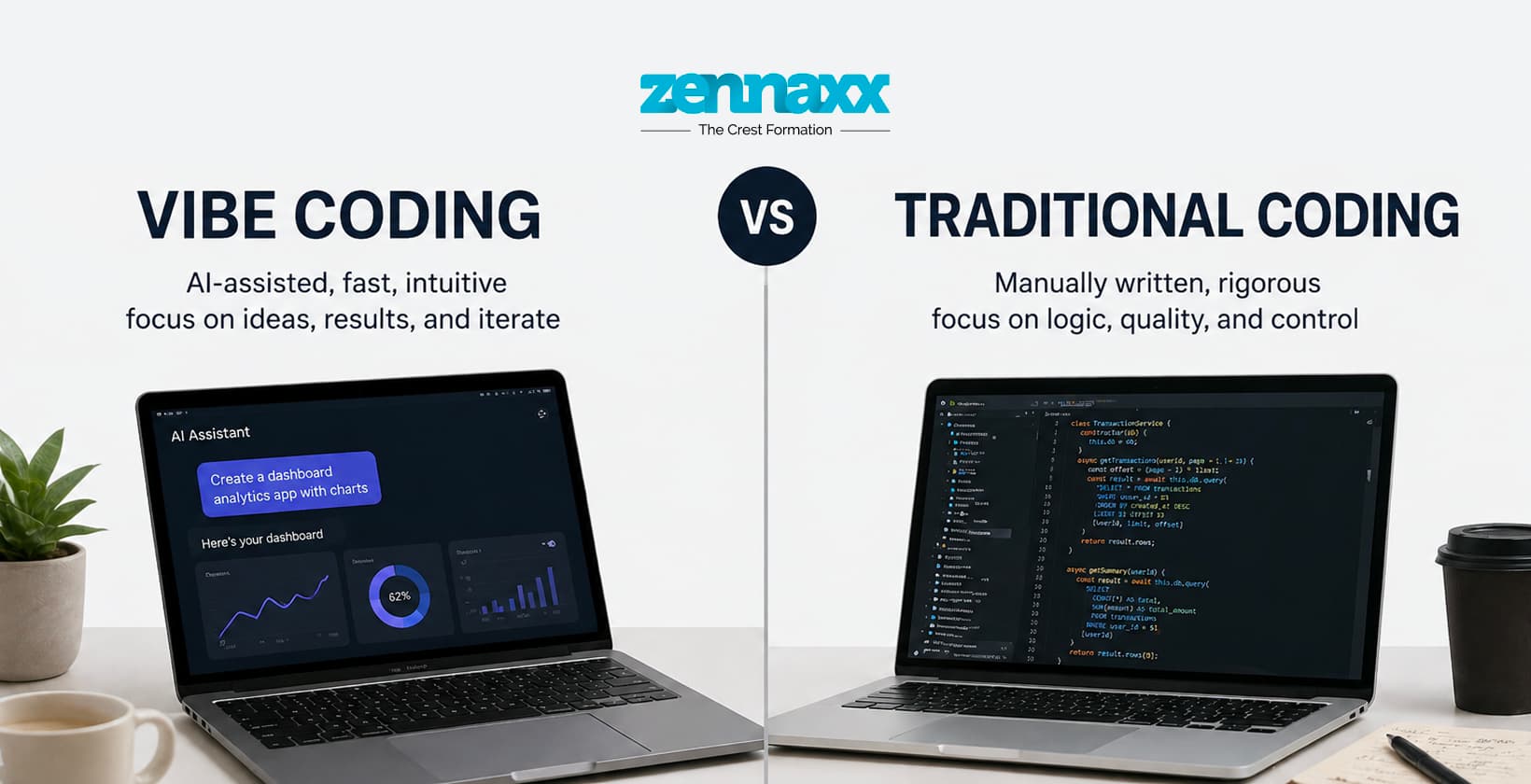
The software world is buzzing with a new phrase – vibe coding. And with it comes a wave of opinions, strong claims, and a lot of confusion. Some say it’s the future of development. Others say it’s a shortcut that breaks things at scale. The truth? It’s somewhere in the middle and it’s more nuanced than most blog posts give it credit for.
This blog clears up any confusion you might have experienced about Vibe Coding vs Traditional Coding. We’ll clear up the most common myths, give you the facts, and be honest about the real limits of both methods so you can make better choices for your project.
What is vibe coding, exactly?
Let’s ensure we have the definitions right before we compare both of them.
Vibe coding is a way to develop software with the help of AI. You write down what you want in simple words, and tools like Cursor or GitHub Copilot make the code for you. You don’t have to write every line by hand. You give the AI prompts, look over what it comes up with, and then quickly repeat the process.It’s fast.
It’s accessible. And it’s changed how many teams – especially startups and solo developers build software.
Writing software manually is what traditional coding is all about. From design to deployment, developers plan the architecture, write every function, deal with logic edge cases, and follow structured processes. It takes a lot of technical know-how, but the end result is code that is well-documented, easy to understand, and built to last.
Both are good ways to do things, but you can’t use them both. And that’s where most myths start: a lack of understanding.
Debunking Common Myths About Vibe Coding and Traditional Coding
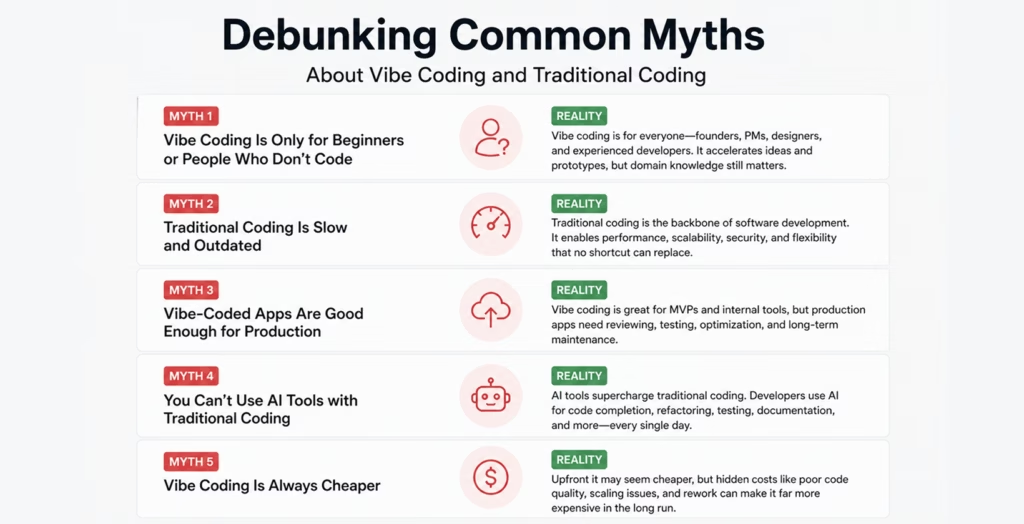
Vibe Coding Is Only for Beginners or People Who Don’t Code
Fact: Many experienced developers use vibe coding to speed up tasks that they have to do over and over again, come up with new ideas, and cut down on boilerplate work. It’s not about how good you are; it’s about how quickly you can do things. Professionals use it as a productivity layer, not a replacement for thinking.
That said, when non-developers use vibe coding without any engineering oversight, the risks go up significantly. The tool is powerful, but understanding what it produces still matters.
Traditional Coding Is Slow and Outdated
Fact: Traditional coding isn’t slow; unplanned traditional coding is slow. When done right with a well-organized Software Development Life Cycle, traditional development is organized, easy to predict, and very scalable. In the long run, teams that follow best practices like clear architecture, code reviews, and automated testing move faster because they don’t have to keep fixing broken code.
“It’s slow” myth comes from comparing early-stage vibe coding (fast prototypes) to full-scale traditional production builds (complex systems). That’s not a fair comparison.
Vibe-Coded Apps Are Good Enough for Production
Fact: For MVPs, internal tools, or testing ideas, vibe coding can help you make a working product quickly. But “working” doesn’t mean “ready for production.
“Production systems need to be checked for security, planned for scalability, handle errors correctly, follow rules, and have code that can be maintained. AI-generated code often skips all of this unless the developer asks for it and checks it carefully. A report from 2026 said that AI-generated code is responsible for 1 in 5 security incidents in businesses. This is a serious number that should not be ignored.
You Can’t Use AI Tools with Traditional Coding
Fact: AI tools are a big part of modern traditional development. The way they are used is what makes them different. AI works as an assistant in traditional workflows, helping with tasks like auto-completion, suggesting refactors, and finding bugs. The developer still owns every line, knows how it works, and makes decisions about how to build it.
The AI controls the output in vibe coding. In traditional coding, the developer drives — and sometimes uses AI to accelerate.
Vibe Coding Is Always Cheaper
The truth is that vibe coding costs less up front. The total cost of ownership (TCO), on the other hand, is a different story. When AI-generated code builds up technical debt, like inconsistent patterns, duplicate logic, and missing documentation, it becomes much more expensive to maintain, debug, and scale over time.
This is especially important for businesses that work with a Custom Software Development Company in Canada or any other mature market where the quality of software over time has a direct effect on business continuity.
Differences That Really Matter : Vibe Coding Vs Traditional Coding
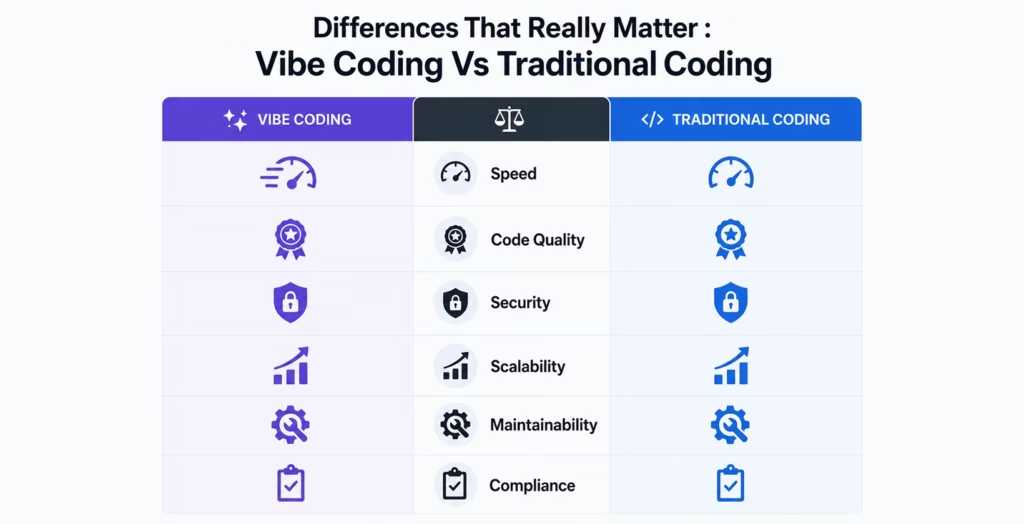
The truth becomes clear once you get past the myths. Here is how Vibe Coding and Traditional Coding compare in terms of important factors in real projects:
Speed: Vibe coding wins at first. You can have a working prototype in a few hours. Traditional development is more structured, but it makes steady, reviewable progress.
Code Quality: When there are good reviews in place, traditional coding makes code that is cleaner and better organized. The output of vibe coding can be neat or messy, depending on how well the prompts are written and checked.
Security: This is where traditional coding is clearly better. Threat modeling, input validation, access control, and compliance checks are all built into the development process. When something breaks or an audit flags it, security is often added after the fact with vibe coding.
Scalability: Systems made with traditional coding are meant to grow. When traffic increases, vibe-coded systems often run into performance problems because the original design didn’t take load into account. This is a hard limit, not just a choice.
Maintainability: A developer knows what their code does when they write it. The developer might or might not write it when AI does. It gets harder to debug, add to, or hand off to new team members over time when codebases are made entirely from prompts.
Compliance: Must in fields like healthcare and finance, like AI in Fintech. GDPR, HIPAA, SOC2, and PCI-DSS all require that processes be documented, data be traceable, and audits be possible. This is naturally supported by traditional development, but not by vibe coding.
Where Vibe Coding Works (and Where It Doesn’t)
There isn’t one way to do every project. It’s more useful to know when to use each than to say one is “better.”
When vibe coding works well:
- You’re checking to see if an idea works or making a minimum viable product (MVP).
- The project is low-risk and only for the company.
- You need a quick proof of concept for a demo or pitch.
- The team is small and working quickly on the early stages of exploration.
- The feature is still in the testing phase and won’t affect sensitive data.
When vibe coding stops working:
- The system has to be able to handle thousands of real users.
- Data privacy and security are not up for negotiation.
- You work in an industry that is regulated
- A team will keep the codebase up to date and add to it over the years.
- It is necessary to connect to complicated old systems or APIs.
When traditional coding works best:
- You’re making a system for production that customers can see.
- Your product is subject to compliance frameworks.
- Several developers need to work together on a codebase that they all use.
- Decisions about architecture have effects on business in the long term.
- The system needs to be checked, written down, or given to someone else.
Real Limits of Each Technique
Let’s be honest: neither method is perfect.
Limits of Vibe Coding:
The biggest problem is who owns it. A lot of the time, the developer doesn’t fully understand the code that the AI writes. When something breaks in production at 2 AM, that becomes a big problem. AI tools also have a hard time with undocumented APIs, legacy systems, and multi-service orchestration, which are all things that enterprise software runs into all the time.
There are also security holes that aren’t obvious. AI models learn from a lot of code, even code that isn’t safe. If you don’t check carefully, vulnerabilities can get into production without anyone noticing.
Limits of Traditional Coding:
There are also problems with traditional coding. Slow onboarding, high upfront costs, longer time-to-market in the early stages, and over-engineering are all real risks, especially for startups where speed is most important.
Also, the quality of the team is very important for traditional coding. A traditional project that isn’t well-structured can be just as bad as a vibe-coded one that hasn’t been looked over.
Smarter Path: Choose Vibe or Traditional Coding Wisely
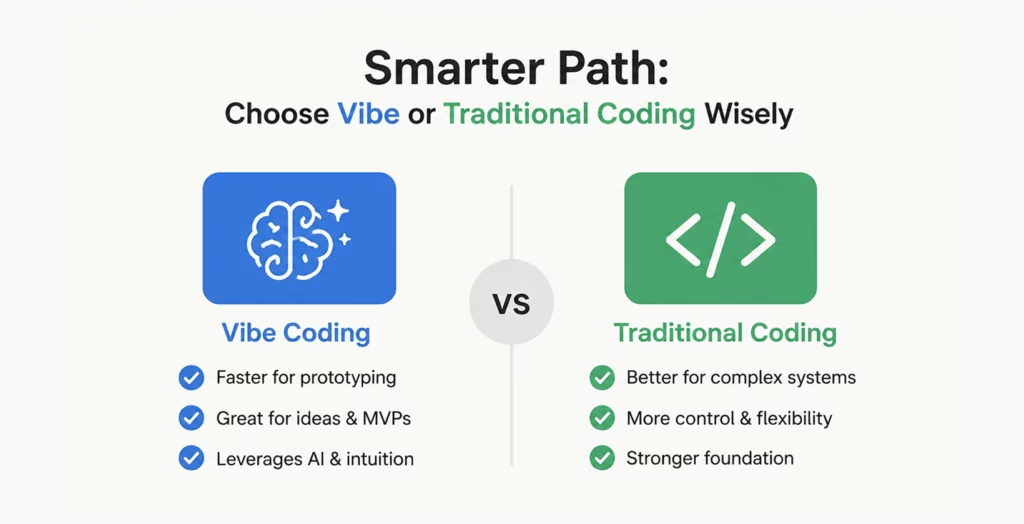
The best development teams today don’t pick one over the other; they use both on purpose.
When you want to explore an idea or make a prototype, start coding quickly with a vibe. Once the idea has been shown to be useful, switch to structured development methods. Before the system goes live on a large scale, break up the AI-generated code into clean layers, add proper testing, set service boundaries, and add security controls.
A good Software Consulting Agency will help you make this change at the right time, before technical debt becomes a major issue and before security holes become a problem.
This mixed method takes into account both the speed of vibe coding and the dependability of traditional development. It’s not about your beliefs; it’s about what your project needs at each stage.
When to Bring in Expert Developers

There’s a point in every product’s growth where the pace of vibe coding starts working against you. Features take longer to add. Bugs are harder to trace. The codebase feels brittle. That’s the signal.
At that stage, bringing in skilled engineers makes more sense than continuing to prompt your way through. Whether you’re looking to Hire Dedicated Developers for a specific module or need a full team to take over the architecture, having professionals who understand both AI-assisted and traditional development is invaluable.
They can audit what’s been built, identify where technical debt is accumulating, and create a roadmap to bring the system up to production standards — without throwing everything away and starting over.
Conclusion
The debate around Vibe Coding vs Traditional Coding isn’t really a debate at all — it’s a spectrum. Both have a place in modern software development. Both come with real myths that cloud good decision-making. And both have hard limits that you’ll run into if you rely on either one exclusively.
The myth that vibe coding replaces engineering judgment is false. The myth that traditional coding can’t benefit from AI is equally false. The facts point to a more pragmatic truth: use the right tool for the right moment, and know when to shift.Build fast when you need to.
Build right when it matters. And when you’re not sure which moment you’re in — that’s when talking to experienced developers makes all the difference.
FAQs
Q1. Is it possible that vibe coding will completely take over traditional coding in the future?
Not likely, at least not for complicated systems that are ready for production. Vibe coding is great for speed and early-stage exploration, but it doesn’t have the architectural depth, security rigor, or code ownership that traditional development does. Even though AI tools are getting better, developers will still need to use their judgment, be accountable, and know a lot about their field. A more realistic future is one where both are more mixed together. AI does more of the boring tasks, and developers only make decisions that really need human thought.
Q2. Is vibe coding safe to use for projects that deal with confidential user information?
If you don’t watch it carefully, it can be very dangerous. AI-generated code can have small security holes, like not checking inputs, weak access control, or not handling data properly, that don’t show up until something goes wrong. If your project will be using personal information, financial records, or health information, any vibe-coded module should be thoroughly checked for security before it touches any real data. It’s best to think of AI output as a first draft that needs to be checked by a professional.
Q3. How can I tell when it’s time to stop coding by feel and start using more traditional methods?
There are a few clear signs that something is wrong: your codebase is getting harder to debug, adding new features breaks old ones, team members have trouble understanding what was built, or your product is getting closer to real users and real data. When compliance, scaling, or long-term maintenance become a priority, that’s another strong sign. At that point, continuing to build only with prompts makes things worse instead of better. Bringing in structured development practices becomes a business decision, not just a technical one.
Q4. If I use vibe coding tools like Cursor or GitHub Copilot, am I not “really” coding?
No, using AI tools doesn’t make software development any less of a skill. AI coding assistants don’t take the place of developers, just like calculators didn’t take the place of mathematicians. The way things get done changes. You still need to know what the code does, look at it carefully, make decisions about the architecture, and take responsibility for what gets shipped. Using tools like Cursor or GitHub Copilot well doesn’t mean that developers are skipping the thought that goes into making good software. They’re just working more efficiently.
Q5. Which way is better for a new business to make its first product?
Vibe coding is a good choice for the very first steps, like validation, MVP, or a proof of concept. It lets you move quickly, test your idea for a low cost, and learn quickly. But as soon as your product starts getting real users or you’re ready to grow, it’s worth putting money into good software architecture and development methods. A lot of startups that take shortcuts early on have to rewrite a lot of their code later on. Getting even the most basic structural choices right from the start, with help from a Software Consulting Agency, can save a lot of time and money in the long run.