
What Is Telehealth Software?
Telehealth software is a digital platform that allows healthcare providers to deliver clinical services, consultations, monitoring, and administrative tasks remotely without the patient ever needing to step inside a clinic or hospital.
Whether it’s a video call with your family doctor in Toronto, a mental health session with a therapist in Ontario, or remote monitoring of a chronic condition anywhere in Canada, telehealth software makes it possible. And in 2025, it has become less of a “nice to have” and more of a core part of modern healthcare delivery.
From hospitals and private clinics to independent practitioners and healthcare startups, organizations of all sizes are turning to telehealth software development to build scalable, patient-first digital health experiences. If you’re exploring this space whether you’re a healthcare business, a startup, or simply trying to understand how it all works this guide covers everything you need to know.
Why Telehealth Software Is Booming in 2026
The global telehealth market is projected to surpass $500 billion by the end of this decade. That’s not just a trend, that’s a transformation. And the drivers behind it are stronger than ever.
Access to healthcare in remote or rural areas has always been a challenge, particularly across provinces like Ontario and British Columbia in Canada. Telehealth software bridges that gap efficiently. Patients no longer need to travel hours for a 15-minute consultation. Doctors can manage more patients in less time. Clinics can cut overhead costs significantly.
The COVID-19 pandemic accelerated adoption, but what’s kept telehealth growing is the genuine value it delivers for patients, providers, and healthcare systems. Regulatory bodies in Canada, the US, the UK, and beyond have also updated frameworks to accommodate and encourage telehealth, making this an ideal time to invest in telehealth app development.
Beyond convenience, telehealth software is now powering chronic disease management, behavioral health, post-surgical follow-ups, elderly care, and even pediatric consultations. It’s redefining what “going to the doctor” looks like and it’s not slowing down.
You can also explore types of healthcare software to understand where telehealth fits in the broader digital health ecosystem.
Key Features of Telehealth Software
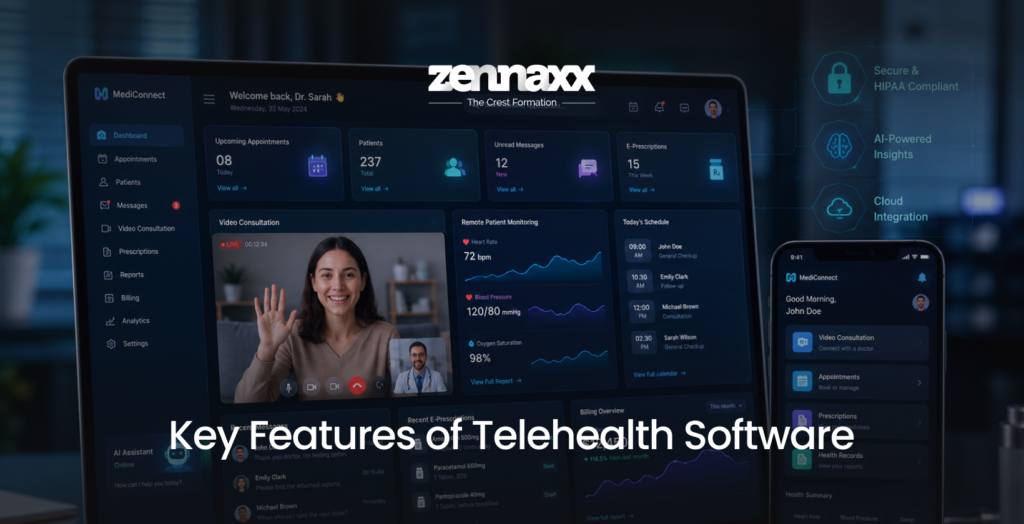
Not all telehealth platforms are built equal. If you’re evaluating existing solutions or planning a custom telehealth app development project, here are the features that matter most:
Video & Audio Consultation
High-definition, low-latency video calling is the backbone of any telemedicine platform. The system must be reliable on both desktop and mobile, with fallback to audio-only when connectivity is poor.
Appointment Scheduling & Management
Patients should be able to book, reschedule, or cancel appointments without calling the front desk. Providers need an intuitive calendar view with real-time availability.
Electronic Health Records (EHR) Integration
Connecting telehealth software with EHR/EMR systems ensures continuity of care. Physicians can view patient history, prescriptions, and diagnostics all in one place, without duplicating data entry.
Secure Messaging & Chat
HIPAA-compliant (or PIPEDA-compliant in Canada) encrypted messaging lets patients ask follow-up questions and receive non-urgent guidance between appointments.
E-Prescriptions
Doctors can send prescriptions digitally to a patient’s preferred pharmacy saving time and reducing the risk of errors.
Remote Patient Monitoring (RPM)
With wearables and IoT devices, telehealth platforms can collect real-time vitals like heart rate, blood pressure, and glucose levels especially valuable for chronic disease management.
Billing & Insurance Integration
Telehealth billing is complex, especially across provinces or states. Integrated billing modules and insurance claim processing streamline the administrative side.
Multi-Platform Support
A strong telehealth solution works flawlessly on iOS, Android, and web ensuring accessibility for all patient demographics.
AI-Powered Features
From symptom checkers and triage bots to predictive analytics, AI is becoming a standard feature in next-generation telehealth software solutions.
For a deeper look at how cloud infrastructure supports these features, read our guide on cloud computing in healthcare.
Telehealth Software Solutions: Types You Should Know
Telehealth isn’t a one-size-fits-all solution. Depending on the use case and patient population, different types of platforms serve different needs:
Store-and-Forward (Asynchronous Telehealth)
Patients submit health data, images, or medical history, which physicians review at a later time. Commonly used in dermatology and radiology.
Real-Time (Synchronous) Telehealth
Live video or audio consultations between patient and provider. The most common and widely recognized form of telehealth.
Remote Patient Monitoring (RPM)
Continuous collection of health data from patients at home using connected devices. Ideal for chronic conditions like diabetes, hypertension, and COPD.
mHealth Apps
Mobile health apps that deliver wellness programs, medication reminders, fitness tracking, and mental health support directly on a smartphone.
Behavioral & Mental Health Platforms
Specialized telehealth platforms for therapy, counseling, and psychiatric care a category that has seen explosive growth post-pandemic.
Understanding which type of telehealth software solutions fits your business model is the first step before development begins.
How Telehealth Software Development Works
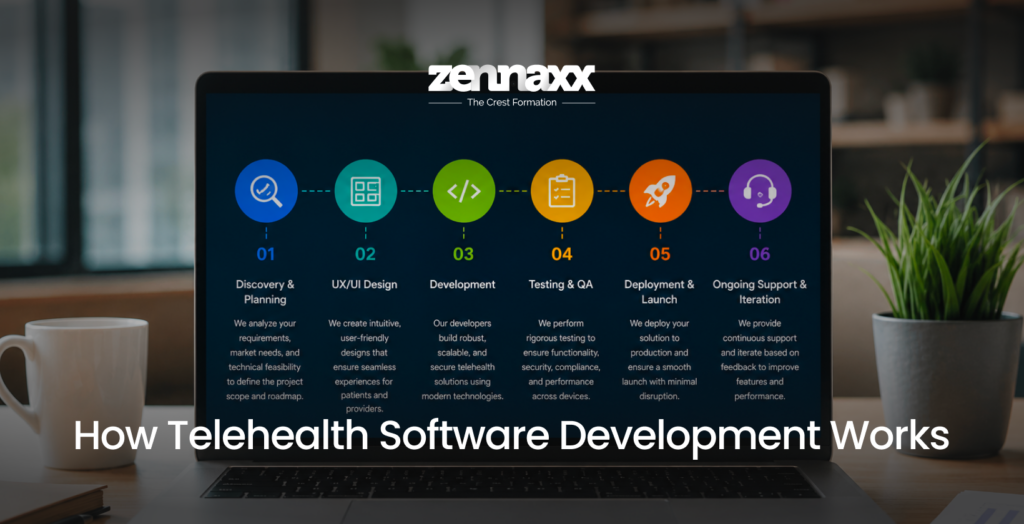
Building a telehealth platform from scratch requires careful planning, technical expertise, and a deep understanding of healthcare regulations. Here’s a simplified view of the telehealth software development process:
Phase 1: Discovery & Planning
Define the product goals, target users, compliance requirements, and feature scope. This phase includes competitor analysis, user research, and technology stack selection.
Phase 2: UX/UI Design
Healthcare users both patients and providers, need intuitive, accessible interfaces. Design must factor in accessibility standards, multilingual support, and mobile-first experiences.
Phase 3: Development
The engineering team builds the front end (patient and doctor apps), back end (APIs, databases, cloud infrastructure), and integrates third-party services like EHR systems, payment gateways, and video SDKs.
Phase 4: Testing & QA
Rigorous testing covers functionality, security, load performance, and compliance validation. HIPAA penetration testing and data encryption verification are non-negotiable.
Phase 5: Deployment & Launch
The platform is deployed to cloud infrastructure (AWS, Azure, or Google Cloud), submitted to app stores if mobile, and launched with user onboarding flows.
Phase 6: Ongoing Support & Iteration
Post-launch, the platform requires monitoring, security updates, feature enhancements, and compliance audits.
Working with an experienced software development company that understands both technology and healthcare is critical to getting this right. Whether it’s a startup or an enterprise, the right development partner can significantly shorten your path from idea to launch.
For a comprehensive overview of the full process, explore our healthcare app development guide.
What Cost is Expected for Telemedicine App Development?
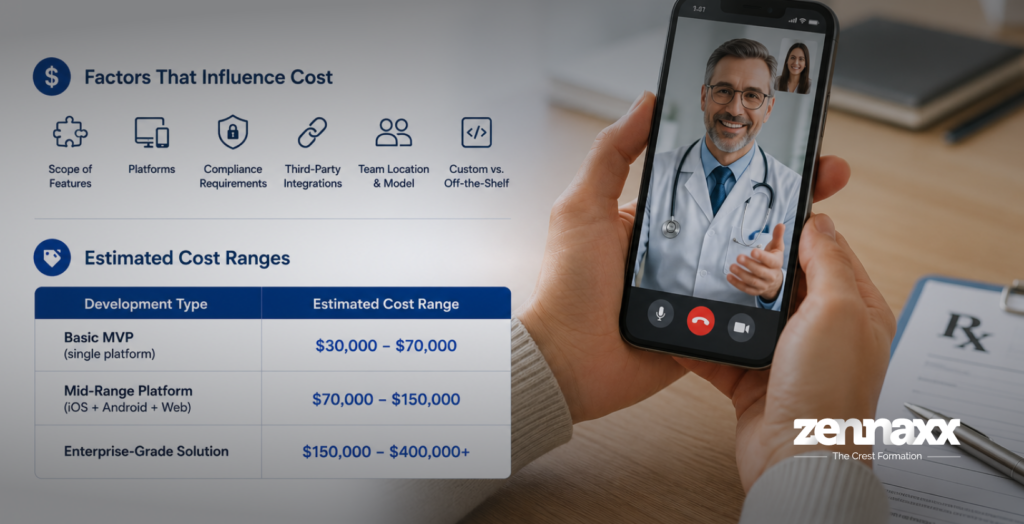
One of the most common questions organizations ask is: “How Much Does It Cost to Build a Telehealth App?” The honest answer is – it depends. But here’s a framework to understand the major cost drivers:
Factors That Influence Telehealth Software Cost
- Scope of Features: A basic MVP with video calling and appointment scheduling costs far less than a full-featured platform with RPM, AI diagnostics, and EHR integration.
- Platforms: Developing for iOS, Android, and web simultaneously increases cost compared to starting with a single platform.
- Compliance Requirements: HIPAA, PIPEDA, PHIPA (Ontario), or GDPR compliance requires specialized development and security architecture.
- Third-Party Integrations: EHR/EMR systems, insurance platforms, pharmacy networks, and IoT devices each add complexity.
- Development Team Location & Model: Onshore vs. nearshore vs. offshore teams have significantly different rate structures.
- Custom vs. Off-the-Shelf: Custom builds are more expensive upfront but offer far greater flexibility and long-term scalability.
Estimated Cost Ranges
These are industry estimates. The actual telehealth software cost for your project will vary based on your specific requirements and the development partner you choose.
Investing in custom software development services from a specialized healthcare app development company can actually be more cost-effective in the long run because you avoid the licensing fees, limitations, and costly migrations that come with generic off-the-shelf platforms.
Compliance & Security in Telehealth Software
Compliance is not optional in healthcare, it’s foundational. Any telehealth software operating in Canada, the US, or internationally must adhere to strict regulatory standards:
Key Compliance Frameworks
- HIPAA (USA): The Health Insurance Portability and Accountability Act governs the privacy and security of patient health information in the United States.
- PIPEDA / PHIPA (Canada): Canada’s federal privacy law (PIPEDA) and Ontario’s provincial health privacy law (PHIPA) regulate how healthcare organizations collect, use, and disclose personal health information.
- GDPR (Europe): For telehealth platforms serving European patients, GDPR compliance is mandatory.
- HL7 & FHIR Standards: Interoperability standards that govern how health data is formatted and exchanged between systems.
Security Best Practices in Telehealth Development
- End-to-end encryption for all video, audio, and messaging
- Role-based access control (RBAC) to restrict data access by user role
- Audit trails and activity logs for all data access
- Two-factor authentication (2FA) for provider logins
- Regular security audits and penetration testing
- Secure cloud hosting with HIPAA/PHIPA-compliant infrastructure
A reliable telehealth software development company will have documented processes for compliance architecture from day one not as an afterthought.
Pros and Cons of Telehealth Software
Like any technology, telehealth software has real strengths and real limitations. Here’s an honest look at both:
Pros of Telehealth Software
- Increased Access to Care: Patients in rural or underserved areas particularly in large provinces like Ontario or Alberta can access specialist care without lengthy travel.
- Reduced Healthcare Costs: Both providers and patients benefit from reduced overhead. No physical space needed for every consultation. Fewer no-shows with automated reminders.
- Improved Patient Engagement: Patients who can communicate easily with their care team are more likely to follow through on treatment plans and preventive care.
- Scalability: A well-built telehealth platform can handle thousands of concurrent consultations with the right cloud infrastructure something a physical clinic cannot replicate.
- Better Data Management: Digital-first platforms generate rich data that can be used to improve care protocols, population health management, and operational efficiency.
Cons of Telehealth Software
- Technology Barriers: Elderly patients or those with limited digital literacy may struggle with video-based consultations. Onboarding and support are essential.
- Internet Connectivity Limitations: In remote areas, poor internet bandwidth can make video consultations unreliable, reducing the quality of care.
- Regulatory Complexity: Operating across provinces or countries means navigating multiple regulatory frameworks simultaneously which requires ongoing legal and compliance attention.
- Physical Examination Limitations: Telehealth cannot fully replace in-person care for conditions requiring physical examination, diagnostics, or procedures.
- Data Privacy Risks: Without proper security architecture, telehealth platforms become targets for breaches. A data leak in a healthcare context carries severe legal and reputational consequences.
How to Choose the Right Telehealth Software Vendors or Development Partner

Whether you’re evaluating telehealth software vendors who offer ready-made platforms, or looking for a telemedicine app development company to build a custom solution, the selection process matters enormously.
Key Questions to Ask
- Do they have proven experience in healthcare software development specifically?
- Can they demonstrate compliance expertise (HIPAA, PHIPA, PIPEDA)?
- Do they offer post-launch support and ongoing maintenance?
- What is their approach to data security and disaster recovery?
- Can they integrate with your existing EHR, billing, or hospital management systems?
- Do they offer transparent pricing and milestone-based delivery?
When to Choose a Custom Build Over an Off-the-Shelf Platform
Off-the-shelf telehealth software providers work well for standard use cases with limited customization needs. But if your organization has unique workflows, specialized patient populations, complex integrations, or strong branding requirements, a custom build is almost always the better long-term investment.
A trusted software development company with healthcare domain expertise will help you define the right approach from the start whether that’s building from scratch, integrating with existing systems, or customizing a white-label solution.
Zennaxx is a healthcare app development company that has helped healthcare organizations, clinics, and digital health startups across Canada and globally build compliant, scalable telehealth solutions. From initial discovery through launch and beyond, the team provides end-to-end custom software development services tailored specifically to the healthcare sector.
Final Thoughts
Telehealth software is no longer a niche solution; it is the future of healthcare delivery. As patient expectations evolve, regulatory support strengthens, and technology continues to advance, the organizations that invest in well-built, compliant, and user-centered telehealth platforms will be the ones leading healthcare forward.
Whether you’re a hospital system in Ontario, a digital health startup in Toronto, a growing clinic network across Canada, or a healthcare entrepreneur with a bold vision, the time to build is now.
Zennaxx is a dedicated software development company with deep expertise in telehealth software development. Our team of engineers, designers, and healthcare compliance specialists work with you from concept through launch, delivering custom software development services that are built to scale, built to comply, and built to make a real difference in people’s lives.
FAQs
1. Can I Hire Someone to Build Me a Telehealth App?
Absolutely. You can hire a specialized telemedicine app development company or a healthcare app development company to build a custom telehealth platform tailored to your specific requirements. The key is to choose a team with proven healthcare experience, compliance knowledge, and a transparent development process. Companies like Zennaxx specialize in exactly this, delivering compliant, scalable telehealth solutions for businesses across Canada and beyond. You can explore our custom software development services for more details.
2. How Long Does It Take to Develop a Telehealth App?
The timeline depends heavily on the scope of features and the complexity of integrations. A basic MVP with video calling, appointment booking, and secure messaging can typically be delivered in 3 to 5 months. A mid-range platform with EHR integration, RPM, and multi-platform support usually takes 6 to 9 months. Enterprise-grade solutions with advanced AI, multi-region compliance, and deep system integrations can take 12 months or more. Working with an experienced telemedicine app development company that follows an agile process will help reduce time-to-market without compromising quality.
3. What Are the Benefits of Telemedicine App Development Solutions for Doctors?
Telemedicine app development delivers significant benefits for healthcare providers: reduced administrative burden through automated scheduling and digital documentation, the ability to see more patients per day with less physical overhead, access to patient history and health records during every consultation, secure digital prescribing, and the flexibility to consult from any location. Beyond convenience, telehealth platforms also help doctors improve patient retention and engagement leading to better health outcomes overall.
4. How Does Telemedicine App Development Help Businesses in the Healthcare Industry?
For healthcare businesses, telemedicine app development opens new revenue streams, expands geographic reach, reduces facility overhead, and improves patient acquisition and retention. Clinics, hospitals, insurance companies, and health tech startups are all using telehealth platforms to differentiate their services in a competitive market. Custom telehealth software solutions also enable better data collection, which supports more informed clinical and operational decisions. Partnering with a proven software development company ensures the platform is built to grow with the business.
5. What Are Online Health Apps?
Online health apps often referred to as mHealth (mobile health) apps are digital tools that help users manage their health and wellness through smartphones or tablets. They range from general wellness and fitness apps to specialized platforms for chronic disease management, mental health, telehealth consultations, medication reminders, and diet tracking. Telehealth apps are a subset of online health apps specifically designed for remote clinical care. As the demand for digital health solutions grows, more organizations are partnering with a healthcare app development company to build custom applications that serve their specific patient population.