Mobile Banking App Development: A Complete Guide for 2026

The way people manage money has changed dramatically. Standing in a bank queue to transfer funds or check a balance feels almost outdated today. Consumers now expect instant, secure, and intuitive financial experiences right from their smartphones. Mobile banking app development has moved from a “nice to have” to a core business strategy for banks, credit unions, and fintech startups alike.
According to Market Research Future, the global mobile banking market is on a steep growth trajectory, fueled by rising smartphone penetration, digital-first consumer expectations, and rapid advances in AI and cloud computing. If you’re considering building a banking app or upgrading an existing one, this guide walks you through everything: types of apps, must-have features, the development process, tech stack, security requirements, costs, and the trends shaping 2026.
What Is a Mobile Banking App?
A mobile banking app is a software application that allows users to perform financial transactions and manage their bank accounts through a smartphone or tablet. Beyond basic balance checks, modern banking apps support fund transfers, bill payments, loan applications, investment tracking, customer support, and much more all within a few taps.
For businesses, a well-built banking app is not just a customer convenience tool. It is a revenue channel, a data asset, and a brand differentiator rolled into one. That is why more financial institutions are partnering with a dedicated Mobile App Development Company Canada to bring these products to life.
Types of Mobile Banking Apps
Before diving into development, it is important to know which type of app aligns with your business model:
Basic Banking Apps- These handle the essentials account balance, transaction history, and simple fund transfers. They are typically offered by traditional banks as their first digital step.
Full-Service Banking Apps- A step above, these include loan management, credit card controls, investment tracking, and customer support, the type of apps offered by major Canadian and North American banks today.
Digital-Only Banking Apps (Neobanks)- Neobanks operate without physical branches. Built entirely for mobile-first experiences, they offer everything from instant account opening to advanced budgeting tools. This is one of the fastest-growing segments globally.
Payment-Focused Banking Apps- These focus on peer-to-peer payments, bill splitting, and merchant transactions. They often integrate with existing bank accounts through open banking APIs.
Business Banking Apps- Tailored for SMEs and enterprises, these include payroll, invoicing, multi-user account access, and treasury management features.
Must-Have Features of a Mobile Banking App
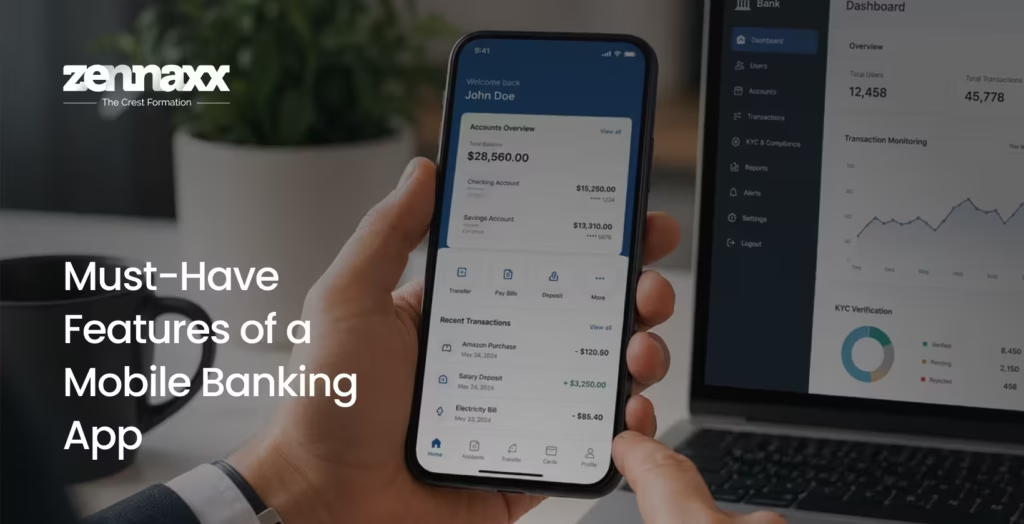 Feature decisions will make or break your app. Here is what users expect and what admins need:
User-Facing Features
- Secure Login & Biometric Authentication – Fingerprint, Face ID, or PIN-based login for instant, frictionless, secure access.
- Account Dashboard – Real-time view of balances, recent transactions, and account summaries at a glance.
- Fund Transfers & Payments – Domestic and international transfers, scheduled payments, and bill pay built for speed and reliability.
- Mobile Check Deposit – Camera-based cheque scanning and instant deposit confirmation.
- Push Notifications & Alerts – Instant alerts for transactions, low balances, or suspicious activity to keep users informed.
- Customer Support (Chat / Call) – In-app support with live agents or AI chatbot integration for 24/7 coverage.
- Card Controls – Freeze or unfreeze cards, set spending limits, and manage virtual card numbers.
- Financial Insights – Spending analytics, budget trackers, and savings goals to encourage healthy financial habits.
Admin Panel Features
- User Management – View, verify, and manage customer accounts with role-based access.
- KYC & Compliance Dashboard – Monitor identity verifications and maintain regulatory filing records.
- Transaction Monitoring – Flag, review, or block suspicious transactions in real time.
- Reporting & Analytics – Business intelligence dashboards for product, compliance, and risk teams.
Advanced Features That Set Banking Apps Apart
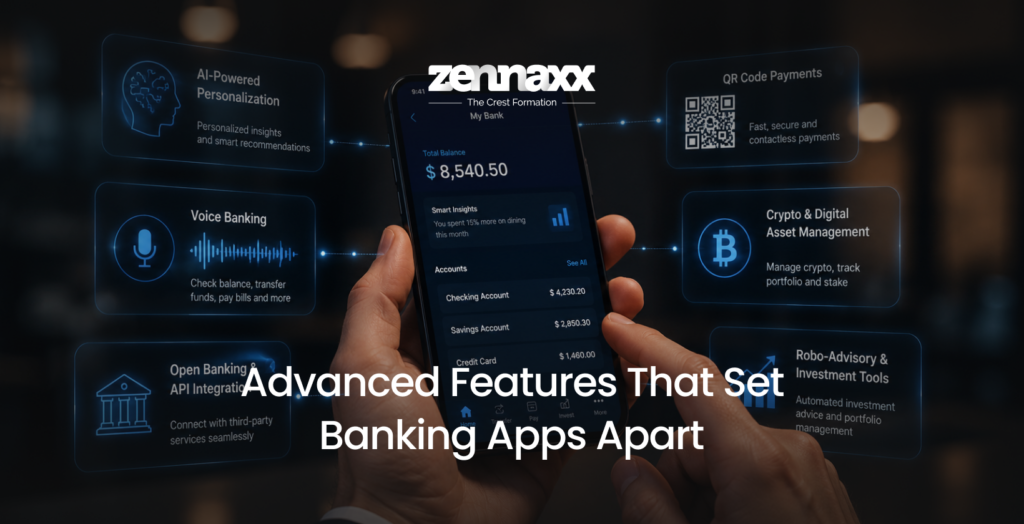
Once core features are covered, advanced capabilities can position your app as a market leader. AI in fintech is already reshaping how banks interact with customers from hyper-personalized spending insights to real-time fraud prevention engines.
- AI-Powered Personalization – Recommend financial products, predict spending patterns, and offer proactive savings tips based on individual user behavior. With AI in app development advancing rapidly, this capability is now accessible even for mid-sized financial institutions.
- Voice Banking – Enable users to check balances, transfer funds, or pay bills using voice commands, powered by natural language processing (NLP).
- Open Banking & API Integration – Connect with third-party financial services, insurance platforms, or investment tools to create a unified financial hub experience.
- QR Code Payments – Fast, contactless payment experiences for retail and peer-to-peer transactions increasingly expected in urban markets.
- Crypto & Digital Asset Management – Support for crypto wallets, staking, and portfolio tracking, especially popular with younger, tech-savvy users.
- Robo-Advisory & Investment Tools – Automated, algorithm-driven investment recommendations for users who want passive wealth management without a human advisor.
How to Develop a Mobile Banking App: Step-by-Step
Market Research & Requirement Analysis (2–4 Weeks)
Understand your target users, the competitive landscape, and the regulatory environment. Define business objectives and key success metrics before writing a single line of code. Skipping this step is the fastest way to build the wrong product.
Define Your App Development Strategy (2–3 Weeks)
Decide on the platform – iOS, Android, or both. Will you go native or cross-platform? Frameworks like flutter app development are increasingly popular for banking apps because they deliver near-native performance with a single codebase, cutting development time and cost significantly. For more on making this decision, read our detailed guide on native vs cross platform app development.
UX/UI Design (3–5 Weeks)
Banking apps must be intuitive and trust-inspiring. A cluttered or confusing UI can directly harm adoption and retention. Focus on clean, distraction-free interfaces with accessible design principles and conduct user testing early to validate flows before development begins.
Backend Development & API Integration (8–14 Weeks)
This is the engine of your app. Set up servers, databases, and APIs that connect your app to core banking systems, payment gateways (Stripe, Plaid, Interac), and any third-party services in your ecosystem.
Frontend Development (8–12 Weeks)
Build the screens and user flows based on finalized designs. Ensure smooth performance, responsive layouts across device sizes, and offline capabilities where relevant.
Security Implementation (Ongoing, 4–6 Weeks Dedicated)
Security is non-negotiable in banking. Implement encryption, multi-factor authentication, biometrics, fraud detection layers, and session management in parallel with the rest of development not as an afterthought.
Quality Assurance & Testing (4–6 Weeks)
Run functional, security, performance, and penetration testing. Simulate high-load scenarios and edge cases before any public-facing release. This phase often catches the issues that would otherwise become expensive emergencies in production.
Deployment & Launch (1–2 Weeks)
Submit to App Store and Google Play, configure production environments, and coordinate a phased rollout to catch any unforeseen issues with real users before a full public launch.
Post-Launch Maintenance & Updates (Ongoing)
Banking apps require continuous monitoring, bug fixes, compliance updates, and feature enhancements. Plan for this as an ongoing operational cost from day one not something to budget for later.
Tech Stack for Mobile Banking App Development
| Layer | Technology Options |
|---|---|
| Frontend / Mobile | Flutter, React Native, Swift (iOS), Kotlin (Android) |
| Backend | Node.js, Python (Django / FastAPI), Java Spring Boot |
| Database | PostgreSQL, MySQL, MongoDB |
| Cloud Infrastructure | AWS, Google Cloud Platform, Microsoft Azure |
| Authentication | OAuth 2.0, OpenID Connect, Biometric SDKs |
| Payment APIs | Stripe, Plaid, Interac (Canada) |
| AI / ML | TensorFlow, PyTorch, Google Vertex AI |
| Security | SSL/TLS, AES-256 Encryption, OWASP Standards |
Flutter app development deserves special mention here. Its hot reload capabilities, rich widget library, and single codebase for both iOS and Android make it a strong choice for fintech teams that want quality and speed without doubling their development budget. It is fast becoming the go-to framework for banking apps built by forward-thinking companies.
Security & Compliance in Mobile Banking Apps
Security is not a feature in a banking app, it is the foundation every other feature sits on. Here is what a responsible, market-ready banking app must include:
End-to-End Encryption – All data in transit and at rest must be encrypted using AES-256 or equivalent standards. No exceptions.
Multi-Factor Authentication (MFA) with Biometrics – Combine passwords with one-time passcodes and biometric verification (fingerprint, Face ID) to minimize unauthorized access risk significantly.
Real-Time Fraud Detection – Machine learning models that flag unusual transaction patterns and either alert users automatically or block suspicious activity outright before damage occurs.
Certificate Pinning & Secure APIs – Prevent man-in-the-middle attacks by validating server certificates directly within the app itself, not relying solely on device-level trust.
Regulatory Compliance – Depending on your market, your app must meet:
- PIPEDA (Canada) – Personal Information Protection and Electronic Documents Act
- PCI-DSS – Payment Card Industry Data Security Standard
- OSFI Guidelines (Canada) – Office of the Superintendent of Financial Institutions
- GDPR (if operating in Europe)
Session Management – Auto-logout after inactivity, device binding, and remote session termination capabilities are expected as standard by both regulators and users.
A trusted Mobile App Development Company Canada will have security compliance expertise integrated into their development process from the start not bolted on after the build is complete.
How Much Does It Cost to Develop a Mobile Banking App?
Development costs vary based on complexity, team location, and the features you need. Here is a general industry benchmark:
| App Type | Estimated Cost Range (USD) |
|---|---|
| Basic Banking App | $40,000 – $80,000 |
| Full-Service Banking App | $100,000 – $250,000 |
| Enterprise / Neobank Platform | $250,000 – $500,000+ |
Key cost drivers include:
- Number of target platforms (iOS, Android, or both)
- Native vs. cross-platform approach (Flutter can reduce overall costs by 30-40%)
- Depth of security and compliance requirements
- Number and complexity of third-party API integrations
- UI/UX design complexity and number of custom interactions
- Ongoing post-launch support model
For a more granular breakdown of what goes into app development pricing, read our detailed guide on mobile app development cost.
Challenges in Mobile Banking App Development (And How to Solve Them)
Security Threats – Invest in penetration testing, threat modeling, and regular third-party security audits throughout the development lifecycle. Do not treat security as a final-phase checkbox.
Regulatory Complexity – Work with a development partner who understands PIPEDA, PCI-DSS, and OSFI guidelines from the discovery phase. Retrofitting compliance after launch is costly and often unreliable.
Legacy System Integration – Use middleware layers and well-documented APIs to bridge your modern mobile app with older core banking infrastructure. In most cases, a full rebuild is neither necessary nor practical.
Scalability Under Peak Load – Design for cloud-native architecture with auto-scaling from day one. Load testing before launch is not optional, it is the difference between a smooth go-live and a headline-making outage.
Cross-Platform Consistency – Frameworks like Flutter deliver consistent UI and logic across platforms. Pair them with rigorous device-specific QA testing to catch edge cases early.
User Adoption & Retention – Invest in onboarding UX, personalized in-app nudges, and regular feature updates. Combining AI in mobile app development with behavioral analytics helps identify and remove friction points that silently kill retention metrics after launch.
Latest Mobile Banking App Trends Shaping 2026
AI & Machine Learning at the Core AI is no longer supplementary in banking apps; it powers fraud detection, credit decisioning, personalized product recommendations, and always-on customer support chatbots. AI in fintech is transforming not just internal bank operations, but what users actively expect from their day-to-day banking experience.
Embedded Finance Non-financial brands are embedding banking capabilities accounts, lending, payments directly into their own apps and platforms. This means banking infrastructure needs to be API-first and built for third-party partnerships from the architecture level.
Blockchain & DeFi Integration Tokenized assets, smart contracts, and decentralized finance tools are moving into mainstream banking apps, particularly for high-net-worth individuals and tech-forward user segments.
Open Banking Expansion In Canada and globally, open banking frameworks are enabling third-party developers to build on top of consented banking data creating new revenue models, marketplace partnerships, and hyper-personalized financial products.
Biometric Evolution Beyond fingerprint and Face ID, behavioral biometrics analyzing how a user types, swipes, and holds their device are being deployed as invisible, continuous authentication layers that flag anomalies without disrupting the user experience.
Super App Convergence Banking apps are expanding well beyond finance embedding insurance, investment, shopping rewards, travel, and lifestyle services into unified platforms, modeled on the super app model that has dominated Asian markets for years.
How to Choose a Mobile Banking App Development Partner
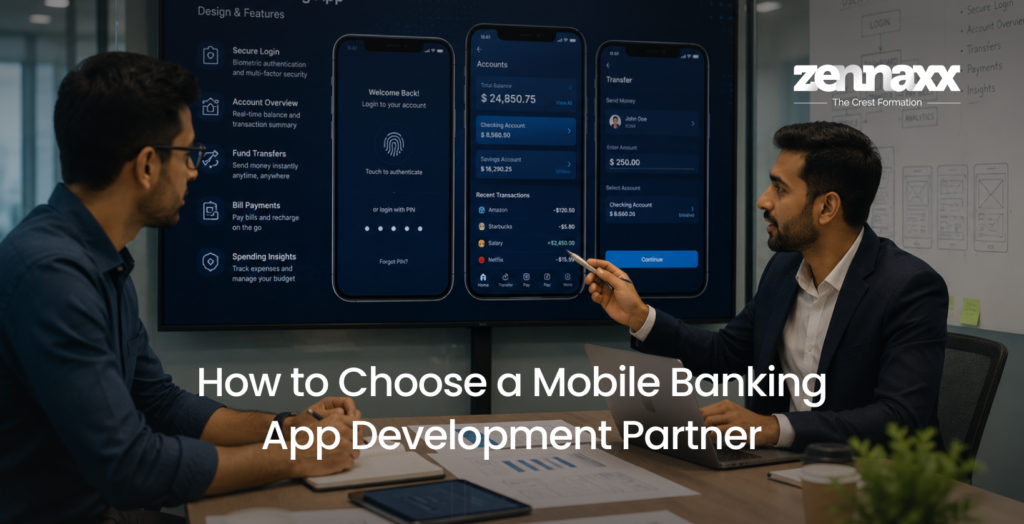
Choosing the right development partner is arguably more important than any technology decision you make. Here is what to evaluate:
Fintech Domain Expertise – Has the team actually built financial applications before? Do they understand the regulatory landscape, security requirements, and nuances of banking UX? Ask for case studies.
Security-First Development Approach – Is security designed into every phase of the software development lifecycle (SDLC), or treated as a final-mile concern? The answer to this question alone can tell you a great deal about the quality of what you will receive.
Scalable Architecture Design – Will the app comfortably handle 10x your current user base without a rebuild in two years? Ask for architecture documentation and scalability planning before you commit.
Post-Launch Support Capabilities – Banking apps require continuous maintenance, compliance updates, and feature releases. Ensure your partner offers SLA-backed support agreements with clear response times.
Transparent Communication – Look for teams that give you genuine visibility into sprint progress, timelines, technical decisions, and blockers not just polished status updates.
Whether you also need CRM software in Canada to manage your banking customers alongside your mobile app, or a complete end-to-end fintech product build, partnering with a team that understands the Canadian regulatory and market context is a meaningful competitive advantage.
Build Your Mobile Banking App with Zennaxx
If you are ready to bring your mobile banking vision to life, Zennaxx is here to help. As a leading App Development Company in Canada, we specialize in building secure, scalable, and compliance-ready financial applications for banks, credit unions, and fintech startups across North America.
Our team brings deep expertise in Flutter app development, AI-powered feature integration, open banking API connections, and end-to-end security implementation — so you get a product that performs reliably from day one and grows with your business over time.Whether you are building a mobile banking app entirely from scratch or modernizing a legacy platform that has held your business back, we partner with you at every stage from strategy and UX design through launch, compliance audits, and beyond. Let’s build the future of banking together.
FAQs
Q1. How long does it take to develop a mobile banking app?
A basic banking app typically takes 4–6 months. A full-service or neobank-grade application usually takes 9–18 months, depending on feature complexity, third-party integrations, and security requirements.
Q2. What platform should I build on first – iOS or Android?
In Canada, both platforms hold substantial user bases. A cross-platform framework like Flutter allows you to launch on both simultaneously from a single codebase, often the most cost-effective approach for startups and mid-market institutions alike.
Q3. How do I ensure my banking app is compliant with Canadian regulations?
Work with a development partner experienced in PIPEDA, OSFI guidelines, and PCI-DSS standards. Compliance must be scoped, designed, and tested from the discovery phase not addressed retroactively before launch.
Q4. What is the biggest challenge in mobile banking app development?
Security and regulatory compliance are consistently the top challenges. They require dedicated expertise, ongoing testing cycles, and a development team that treats them as foundational requirements not optional layers added at the end.
Q5. Can I use Flutter for a banking app?
Absolutely. Flutter is increasingly used for production-grade financial applications. Its performance, security plugin ecosystem, and ability to target both iOS and Android simultaneously make it a smart and economical choice for mobile banking app development projects.