What is HIPAA-Compliant App Development?
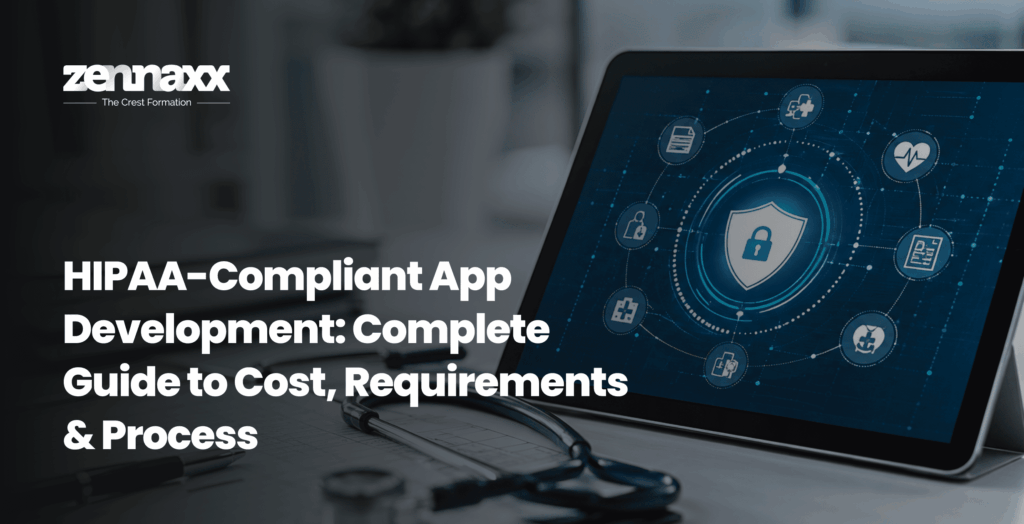
HIPAA-compliant app development means developing mobile or web applications that comply with the security, privacy, and data protection regulations set by the Health Insurance Portability and Accountability Act (HIPAA). In short, if your app collects, stores, processes, or transmits any kind of patient health information referred to as Protected Health Information (PHI), then it must be built in a way to keep that information safe, private and handled correctly at every single step.
This is not a checkbox exercise. HIPAA compliance covers everything from how data is encrypted to who is allowed access to it, to how long records are kept, to what happens if there is a breach. If you are building a telehealth software, a patient portal, a remote monitoring app or a clinic management tool, hipaa compliant app development has to be baked into the architecture from day 1 and not added as an after thought once the app is already built.
Getting this right is a non-negotiable for healthcare businesses everywhere in Canada, including Toronto and Ontario and the US. It is the basis for everything else.
Why HIPAA Compliance is More Important Now Than Ever
Healthcare data is among the most valuable, and most confidential, information in the digital world. And the numbers explain why compliance isn’t optional any longer.
Healthcare data breaches are now considered the most expensive of any industry, with the average breach costing millions of dollars per incident and taking months to fully identify and contain. The legal fallout is just as bad as the financial fallout. Violating HIPAA can cost you between a few hundred dollars per violation and over $2 million. If someone intentionally misuses patient data, they can face criminal penalties that include hefty fines and even jail time.
But it is not just about fear of punishment. In the healthcare industry, HIPAA compliance has become a real trust signal. It’s not a compliant product so hospitals, insurance companies and enterprise healthcare buyers just won’t look at it. Patients are also much more aware of data privacy today, and they’re much less likely to use or trust an app that doesn’t take their information seriously.
As digital health accelerates from telemedicine to AI-driven diagnostics to remote patient monitoring, the need for secure, compliant infrastructure is only growing. This is precisely the reason many healthcare organizations are reaching out to a trusted mobile app development company that understands the technology along with the regulatory landscape.
HIPAA Mobile App Requirements: What Your App Needs
The first step in any development project is to understand the core requirements of the HIPAA mobile app. HIPAA is made up of four core rules but the Security Rule and Privacy Rule are the most applicable to app developers.
The Privacy Rule specifies when PHI may be used or shared, gives patients access to their own health data and the right to correct it, and requires that apps collect only the minimum amount of information necessary for their operation.
The Security Rule requires certain protections that are divided into three groups:
- Technical Safeguards- encryption, access controls, audit logs, and authentication, these are mostly owned by app developers
- Administrative Safeguards- policies, training, and risk assessments managed by the healthcare organization
- Physical Safeguards- controls over the physical devices and locations where PHI is accessed or stored
Basic technical requirements for all HIPAA-compliant apps:
- Encryption at rest using AES-256 for all stored PHI never saved in plaintext
- Encryption in transit with TLS 1.2+ (TLS 1.3 is the new preferred standard)
- Unique user identification with role-based access control (RBAC)
- Multi-factor authentication (MFA) for any account accessing PHI
- Audit controls and immutable logs that record every instance of PHI access
- Integrity controls to prevent the unauthorized alteration or deletion of data
Equally important is understanding the distinction between transient PHI access (data processed on a temporary basis and not stored) and persistent PHI access (data stored long term in the system). Each requires a different level of protection, and your app’s architecture should clearly separate the two from the very beginning.
A technically perfect app can still lead to a violation if the organization employing it doesn’t adhere to proper administrative processes, making compliance a shared responsibility between the development team and the healthcare provider.
Step-by-Step Process of HIPAA Compliant App Development
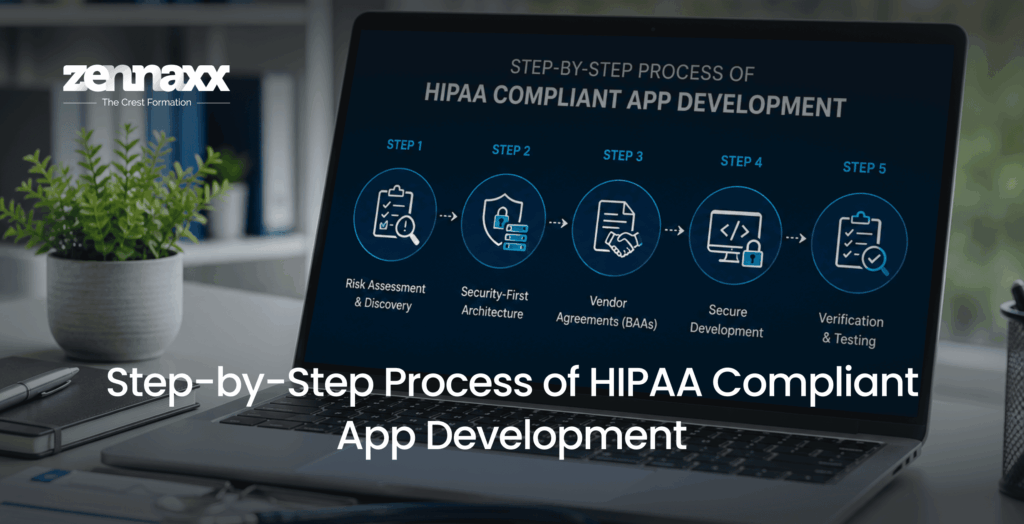
Developing a healthcare app that meets compliance is a methodical, security-first process. Here’s how a seasoned development team does it:
Step 1: Risk Assessment & Discovery
The team conducts a gap analysis to understand exactly what PHI the app will handle, how it will flow through the system, and what risks exist at each touchpoint.
Step 2: Security-First Architecture
Instead of designing the app first and then bolting on security, the whole technical architecture, database structure, API design and cloud infrastructure is planned with compliance requirements in mind from the beginning.
Step 3: Vendor Agreements (BAAs)
Business Associate Agreement (BAA), Third-party vendors who interact with PHI include: cloud hosting providers, analytics tools, or customer support platforms. That means ensuring your cloud provider (AWS, Azure or Google Cloud) is configured within HIPAA-eligible boundaries, as default settings are often not compliant out of the box.
Step 4: Secure Development
Developers develop the application with encryption, access controls, and audit logging built in as architectural decisions, not as bolt-on features. Mobile-specific protections like certificate pinning, secure local storage (iOS Keychain or Android Keystore) and jailbreak / root detection are implemented to prevent data leaks on compromised devices.
Step 5: Verification & Testing
This phase includes rigorous QA, professional penetration testing and a compliance audit designed to identify encryption gaps, missing access controls or weak authentication before launch.
Step 6: Pre-Launch Checklist & Continuous Compliance
The team conducts breach notification processes, final security checks and documentation before going live. Compliance doesn’t end at launch. It must be monitored on an ongoing basis, risks must be assessed on a regular basis and HIPAA mobile app requirements must be updated as regulations change.
In principle, this is how other regulated or security-sensitive apps are built. If you’re curious about how it compares across industries, take a look at our guides on mobile banking app development and stock trading app development that also need bank-grade security architecture.
HIPAA App Development Cost: A Realistic Breakdown
One of the most common questions healthcare businesses ask is: how much does HIPAA-compliant app development actually cost? The honest answer is that hipaa app development cost heavily depends on scope, but here’s a realistic framework based on current industry benchmarks:
General Cost Ranges
The simple overhead of compliance adds, on average, 15-25% to the normal development costs for additional encryption layers, audit-logging systems, access-control infrastructure, and compliance documentation.
Other expenses to consider are:
- HIPAA-compliant hosting- typically $200 to $2,000+ per month depending on data volume and log retention requirements
- Third-party security audits- Independent HIPAA audits typically cost $5,000 to $50,000 depending on the depth.
- Legal & BAA fees- drafting and reviewing Business Associate Agreements with a healthcare attorney usually ranges from $2,000 to $10,000
- Continuous maintenance- Set aside 15-25% of your initial development cost each year for patches, updates and ongoing compliance monitoring
To get a broader sense of how development pricing works across project types in the Canadian market, check out our guide on app development cost in Canada that breaks this down further.
It’s worth repeating: retrofitting compliance into an app built without security from the ground up can cost three to five times more than building it right the first time. Investing in proper hipaa compliant app development from day one is not only safer but is also a lot more cost effective in the long run.
Key Features of a HIPAA-Compliant App
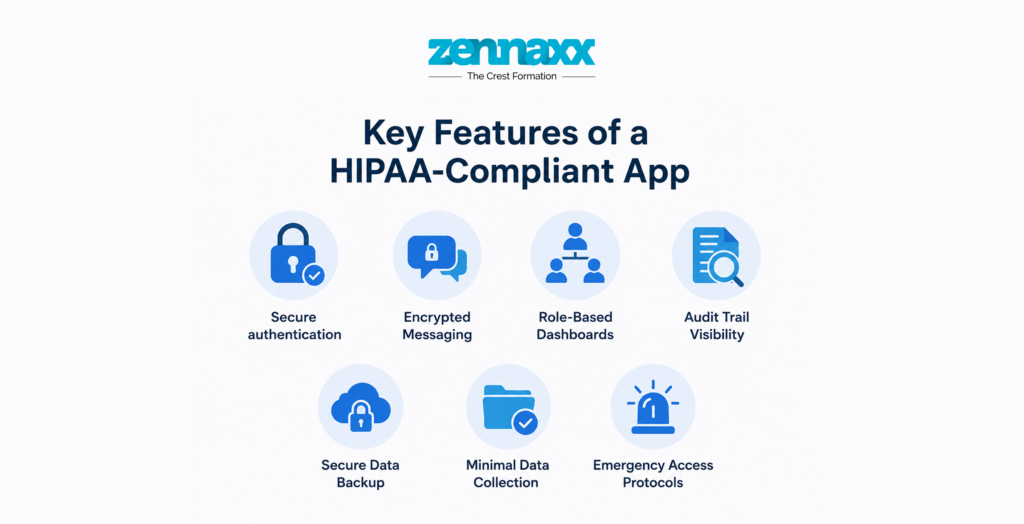
Besides the technical safeguards that we have already discussed, here are the functional features that make a HIPAA compliant healthcare app truly useful and trustworthy:
Secure authentication- Multi-factor authentication, biometric login options and strong password policies should be standard, not optional extras.
Encrypted Messaging- In-app communication between patients and providers needs end-to-end encryption, not just standard SSL.
Role-Based Dashboards- Only the information relevant to the role of doctors, nurses, administrative staff, and patients should be displayed.
Audit Trail Visibility- A detailed, tamper-proof log of who accessed what data and when, which is critical for both compliance and internal accountability.
Secure Data Backup- Backups should be automated and encrypted so that data is not lost and backups themselves must be encrypted as an unprotected backup is as risky as an unprotected live database.
Minimal Data Collection- The best HIPAA compliant apps only collect the data they need to. That means that if something does go wrong, less data is collected to put at risk.
Emergency Access Protocols- A secure way to gain authorized access during outages or emergencies, while still fully logging every attempt at emergency access.
And if your healthcare app will be incorporating broader functionality, it’s worth checking out our full healthcare app development guide for a comprehensive view of what a modern, patient-centric platform should contain.
Common Mistakes That Lead to HIPAA Violations
Mistakes happen. Even the best-intentioned teams make mistakes that put their app and their business at risk. Most common ones are here:
Compliance should not be an afterthought- Trying to bolt on security once development has been completed almost always leads to gaps, rework and much higher costs.
No BAAs with vendors- Any vendor that has any contact with PHI, even momentary, needs a signed Business Associate Agreement . This step is one of the most common and most costly oversights.
Storing PHI in device caches or in plain text- Mobile apps that cache data locally without encryption are a serious vulnerability, especially if the device is lost or stolen.
Weak or missing audit logs- Without a clear, immutable record of who accessed what data and when, it is nearly impossible to properly investigate or respond to a potential breach.
Default cloud configurations- Although cloud platforms like AWS and Azure have HIPAA-eligible services, they are configured by default in non-compliant ways that require explicit, correct configuration.
Continuous maintenance- HIPAA compliance isn’t a one-and-done. Security threats change, regulations change and apps that aren’t continually patched become non-compliant over time.
Benefits and Drawbacks of HIPAA Compliant App Development
Advantages
Builds Patient and Partner Trust- A HIPAA-compliant app lets patients, hospitals and insurance companies know you care about data privacy making partnerships and patient adoption much easier.
Avoids Costly Penalties- Solid compliance from the beginning protects your business from crippling fines, legal fees and damage to your reputation.
Long-Term Scalability- Apps built with a good security architecture tend to scale better as you add features, users and integrations down the road.
Competitive Advantage- Compliance can be a true differentiator in a crowded digital health market especially when working with enterprise healthcare clients.
Disadvantages
Higher Upfront Investment- Development with compliance in mind will usually be more expensive than a standard app, due to the extra security layers, audits and documentation.
Longer Development Timelines- Building in proper safeguards, testing and validation takes more time than a typical consumer app build.
Ongoing Maintenance Burden- Compliance is not a one and done task. It requires ongoing monitoring, updates and periodic re-audits. There are ongoing costs associated with that.
Complexity of Vendor Management- As more third-party tools and APIs get integrated, managing BAAs and vendor compliance becomes complex.
How to Choose the Best Mobile App Development Company

Choosing the right development partner can make or break your HIPAA compliant app project. What to watch for:
Proven healthcare experience- Ask for case studies or examples of past compliant builds, not just generic app development work
Compliance first mindset- The team should discuss security architecture from the first conversation, not as an afterthought.
Transparent process and pricing- Milestone-based delivery and clear documentation throughout the project reduce risk on both sides.
Post-launch support- Compliance is not a one-time thing so your development partner should offer ongoing maintenance, monitoring and updates after you go live.
Cross-industry security expertise- Teams with experience in other regulated industries, such as finance, often provide valuable security discipline to healthcare projects as well.
A reliable mobile app development company with experience in the healthcare domain will guide you through each step, from the initial risk assessment to post-launch compliance monitoring. Zennaxx provides end-to-end mobile app development services for regulated industries. We help healthcare companies in Canada including Toronto and Ontario to develop secure, scalable and fully compliant apps.
Final Thoughts
Building a HIPAA-compliant app isn’t just about avoiding fines, it’s about building trust, protecting patients and creating a healthcare product that can scale safely for years to come. Healthcare organizations that buy into compliance-first architecture from the beginning are always more cost-effective, free of legal headaches, and more quickly trusted by patients and partners than those who try to retrofit security after the fact.
Whether you’re a healthcare startup in Toronto, a growing clinic network across Ontario or an established provider anywhere in Canada, the right development partner makes all the difference.
Zennaxx is a trusted mobile app development company with proven experience in building secure and compliant healthcare applications. We merge security expertise, regulatory knowledge, and considerate design to provide app development services that healthcare companies can truly rely on.
FAQs
1. How Much Does It Cost to Build a HIPAA-Compliant App?
The cost will depend a lot on how complex it is. A basic MVP will typically cost $50,000 to $100,000, whereas a mid-range app for iOS, Android and web can cost $100,000 to $300,000. Enterprise-level platforms with advanced integrations can cost anywhere from $300,000 to millions of dollars. Then add the cost of compliance . You’re going to add 15-25 % to the base development costs for encryption, audit systems, security audits, and legal fees for Business Associate Agreements on top of the base development costs . Also, you can check out our detailed breakdown of the app development cost in Canada to get more insights.
2. What Are the HIPAA Requirements for Healthcare Apps?
HIPAA requirements for healthcare apps are derived from the Security Rule and Privacy Rule. This translates into AES-256 encryption for data at rest, TLS 1.2 or higher for data in transit, multi-factor authentication, role-based access control, automatic session timeouts, and detailed audit logs that track every instance of PHI access. “On the privacy side, apps should collect minimal patient data and should allow users to access and manage their health information. Administrative requirements such as staff training and signed BAAs with all vendors are just as important and need to be handled in parallel to the technical build.
3. Can I Build a HIPAA Compliant App Without a Developer?
Technically, no-code and low-code platforms are out there, but the risk of building a genuinely HIPAA compliant app without experienced developers is extraordinarily high. Compliance requires solid technical implementation, a sound encryption architecture, a secure authentication system, immutable audit logging, and properly configured cloud infrastructure that is far beyond what most no-code tools are able to reliably provide. Even small gaps in security architecture can cause serious breaches and penalties. For a healthcare product that handles real patient data, partnering with an experienced mobile app development company is the safer and more reliable path by far.
4. How Long Does HIPAA-Compliant App Development Take?
Timelines depend on the scope. A simple MVP with core compliance features can often be delivered in 4-6 months. A mid-range platform with EHR integrations, advanced security layers and multi-platform support typically takes anywhere from 6 to 10 months. Enterprise-grade builds with AI capabilities, multi-region compliance and deep system integrations can take 12+ months. Building compliance in from the start rather than retrofitting it later helps to keep timelines more predictable and avoid costly delays.
5. Do All Healthcare Apps Need to Be HIPAA Compliant?
Not all health apps need to be HIPAA compliant. An app needs to be HIPAA compliant if the app handles Protected Health Information (PHI) on behalf of a covered entity or business associate. General wellness apps, which don’t collect identifiable health data related to medical care, may not be covered by HIPAA. Any app used by a health care provider, insurer or their vendor to store, process or transmit patient health information must comply, though. If you are unsure, you probably want to speak with both a healthcare compliance attorney and an experienced development team before you launch.